















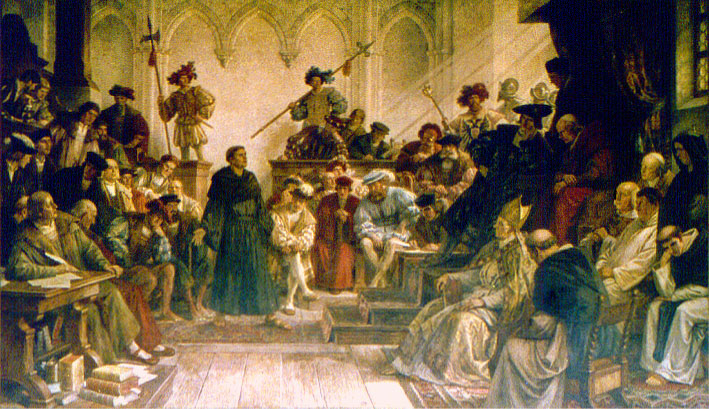
On trial for his life, Martin Luther was faced with the demand that he recant his writings. And he replied as follows:
Your Imperial Majesty and Your Lordships: I ask you to observe that my books are not all of the same kind.
He then went on to classify his writings into three large groups. The first, he said, consisted of writings about Piety in morals and faith, and that even many of his adversaries found no fault in them. How could he, he wondered, recant of something which everyone agreed was truth?
The second group, he said, were aimed at “papists and the papacy,” and that in them he had supplied scriptural evidence for the errors of the Roman hierarchy.
The third group consisted of replies to, and critiques of, individuals who had opposed him and supported the papacy.
Finally, he said, in effect, “Show me where the Scriptures refute what I’ve written, and I will recant those errors.”
In the previous blog entry I said that the writings of Ellen White can be authoritative, not simply are authoritative.Why did I say that? Well, first we have the simple issue of whether or not her writings have been accepted as authoritative in that body, or to that audience. This means that her writings are not authoritative to those who have not ratified her gift, usually this translates to those outside the denomination.
But then we have the same sort of job to do that Luther did concerning his writings. To paraphrase Luther, “I ask you to observe that Ellen White’s writings are not all of the same kind.”
For example, there are books that she wrote on a particular topic. Education and Ministry of Healing are two examples. These are the two books where she directly and comprehensively address the issues of education and health.
Then we have the books we call The Conflict of the Ages Series. These provide her understanding of God’s interaction with His people throughout time, stretching from Creation to The Second Coming. Although they draw upon the Bible, they are not strictly commentary on the Bible, nor they limited to what is in the Bible. In many ways they are class unique and of themselves.
Then we have a sort of catchall category including testimonies to individuals, letters to groups and committees, and a whole range of things.
Finally, we have a list of books which consist almost solely of her words, but are essentially lists of excerpts of the other categories writings, assembled by topic. These are called compilations.
The fact that we have so much of her work, and that it occurs in these varied forms, presents us with both opportunities and difficulties. The opportunities we grasped quickly as a people, recognizing an invaluable source of counsel. The difficulties arise — as they do with the Scriptures — and how to interpret and to apply the information provided in these writings.
So when we’re talking about authoritative, we have to address each of these different categories separately. I will start with the compilations, which are at once the easiest and most difficult group.
They are the easiest to deal with because, although she wrote all the words contained within them, she did not write them. That is, she did not select and order the passages within them. Neither did she have a hand in which topics are emphasized, except in the most indirect fashion. It could be argued that whatever she mentions most often is also the most important, but there are other factors complicating that simple view. In the end, someone else — someone decidedly not ratified as authoritative by the body — made all the significant choices, beginning with which passages to include in which to exclude.
I am reminded of the old joke in which the man said he made all the major decisions in his family, and his wife made all of the minor decisions. But one of the minor decisions was which decisions were major, and which ones minor. In other words, his wife decided who got to decide what.
One can apply that same logic to the compilations. Ellen White got to make all the major decisions, she received divine inspiration, she wrote all the words. But the compiler decided which passages applied to the topic at hand, and which did not. Even more subtly, the compiler decided the order in which those passages appeared, and how they were emphasized.
The compilations are the most difficult to deal with because they are all her words, and assembled topically as they are they can make a formidable case. Whether that is the case she was making in each of those passages is another matter. But in the compilation much of the ambiguity is eliminated. And let’s face it, they are convenient. I have book that is essentially a topical index of all of C. S. Lewis’ writings. I love it. It’s convenient. Reading Lewis, however, is quite a different thing. The same is true of Ellen White. Sometimes a passage from her writings appears quite different in the compilation than it does in its original context.
Let me give you a personal example. As a teacher in Seventh-day Adventist elementary schools, I commonly kept four of Ellen White’s books either on or in my desk. Education, Counsels on Education, Fundamentals of Christian Education, and Child Guidance.When confronted with a particular behavioral problem, or educational challenge, I usually went to the compilations. For behavioral problems, I referred to Child Guidance. For educational challenges, I might look up the topic in Counsels on Education, or Fundamentals of Christian Education. The last two were handy in dealing with school board issues, as well.
But to understand Ellen White’s total vision of the process of education, I made it a practice to read through the book Education every year. Only in that book did she purposely set forth her understanding of the purpose and function of true education. The other books, while useful, consist of the bits and pieces of counsel given to different people in various situations. To really understand what they meant, I needed to understand the larger vision, the greater context from within which she spoke.
A dear friend of mine repeatedly read Ministry of Healing. He tells me, and it seems obvious when I think about it, that it provides the context for all of her many counsels concerning health.
The upshot of all this is that compilations should be used cautiously, and always in the context of her total vision of the topic. If you want to understand what she believed about the nature of Christ, read Desire of Ages. Any obscure quotation which appears to contradict the larger view of Jesus presented in Desire of Ages is probably a misinterpretation.
Finally, there are what I call the “personal compilations.” That’s what I call the list of quotations that individuals have assembled for themselves. These generally consist of someone searching for quotations to support the conclusion they began with, rather than a conclusion arrived at from a considered reading of all her works.
So, are compilations authoritative? Is there a simple answer to that question? I suggest to you there is not. It would be nice if God had written His absolute will in letters of fire. But if He had, would there be need for us to engage the text seriously? To wrestle with the Angel of divine revelation? Apparently, His spelling it all out for us would not be the best way; for if it were, we can be assured that God would’ve done it that way. But he did not.
Next time, the Testimonies, and other personal/direct communications.

ok so what then
One of the problems is that we have a notion that when a writing is inspired, that it is inspired word for word. I used to think so myself. But if you believe Ellen White was inspired–as I do–then we need to accept what she tells us about how inspiration works. You can find that here: http://www.whiteestate.org/issues/rev-egw.html
“God has not put Himself in words, in logic, in rhetoric, on trial in the Bible. The writers of the Bible were God’s penmen, not His pen. ”
A belief in verbal inspiration leads in only two directions: fanaticism, or disillusionment. Her works are authoritative for the church to whom her testimony was given. But authoritative is a different issue than whether they were true.
Whenever we cite Ellen White– or scripture– as authoritative, and mis-apply it, that is, apply it to circumstances substantively different than those to which it was given, we do damage to the authority of the prophet.
Gillmour, could you clarify what you mean?
its either we conclude her writings are authoritative or we dont question such, or bring issues which might question that
Hi Gillmour. Thanks for the clarification.
The point of the article isn’t that some of Mrs. White’s writings are inspired and others aren’t. The point is that Adventists should avoid citing her writings as an authority with those who do not recognize them as such. The same could be said of the Bible; it is easier to witness to an unbeliever by living the gospel than by merely telling them they should believe because of the words contained in a book they don’t recognize as an authority.
As far as compilations go, Ed’s point is simply that readers should find out everything Mrs. White had to say on a subject and not necessarily trust that uninspired compilers accurately represented Mrs. White’s counsel on a particular subject.
ok i get you..but how do we know now, which ones are original from her and the ones that are from compilers. Because my fear comes from that, if we are not informed and identify the compilers ones, we might find someone out there after reading this questioning also the original ones. So thats why i had said, its better not to bring issues that might question the whole thing
Most (all?) official compilations cite the original works paragraph by paragraph. There should also be a foreword at the beginning of the book that identifies it as a collection of her other writings on a specific topic.
Gillmour, I work for OUTLOOK (of course my views are my own, and I don’t speak for the organization).
I understand your concern that we not try to undermine Adventist belief in Mrs. White’s prophetic gift.
It seems to me, however, that we’ve largely become afraid of questions. And this is contributing (if not causing) a crisis in our church (at least in North America). If the Bible is God’s Word, and if Mrs. White’s writings are indeed inspired, surely they can hold up to some scrutiny.
We should never be afraid of questions. I believe we need to acknowledge people’s questions and doubts. If we instead stifle them, we’ve lost.
Randy Harmdierks , we can have an anlysis of what was God saying in Genesis 1:27, but its a different thing when we question the authoritativeness of Genesis as the Word of God. We can analyse and question what Ellen White was inspired to say and write in Ministry of Healing..but my concern was most of all about questioning the authoritativeness of her writings. Ofwhich i do understand as some comments(from above) has highlighted that, its about the originality, which can be identified by some markers on her writers which we need to be aware of when we come across compiled material
I understand the distinction, and it’s an important one. But we have to identify who “we” are. I agree that it’s not a good thing for a movement to undermine Genesis, for example, as the Word of God. But if someone has sincere questions or doubts about whether Genesis is authoritative as the Word of God, we need to be accepting of their questionings. We need to make room for the Holy Spirit to guide us as we deal with those questions and doubts. If we instead stifle the questions, if we make people ashamed to have doubts and questions, if those questions go unanswered (or at least not answered to their satisfaction), we create the very thing we were trying to avoid: a movement within the movement that no longer believes in the authoritativeness of Genesis as the Word of God.
but at the end of the day..God is still God without evidence. Thats the same with His word..The just shall live by faith..the moment we start to doubt or question His existence then we might end up were we actually deny faith. Questions are good but not doubts..doubting is the opposite of faith. So i say, yes let the church be open to questions about a certain topic, but never for doubt
I’m not sure that we disagree so much as that we’re approaching the topic from completely different angles. You’re right, if a whole movement is full of doubt, there’s a faith problem.
But what about the individual who harbors doubts? God is God without evidence, sure. And math is math without a knowledge of how it works. But if we don’t expect a young child to understand calculus, why would we expect someone young in faith to be free of doubt? A seed cannot be expected to behave as a mature plant. Nor should they be punished for being a seed.
Growth is a process. How will their doubts ever be replaced by faith if we don’t give them room to grow? How can the seed become a mature plant if we don’t acknowledge or help remove the umbrellas preventing the water provided by the Holy Spirit to reach them?
I don’t doubt that Ellen White was inspired. But when anything is taken out of context, it can be misunderstood/misinterpreted.
You might want to look at an article concerning doubts, by the way.
http://www.signstimes.com/?p=article&a=40049215129.739
Ed, thank you for sharing that. Those are very important distinctions and much more articulately spelled it out than I could.
I had more time to devote to it.