















As soon as I entered the building, I felt exactly as I had a decade earlier. Someone else occupied the principal’s office now. The same classrooms greeted me, though each arranged differently than in my memory. Yet with all the changes, I took a deep breath— and knew why. They still used exactly the same sweeping compound as when I served there. I didn’t see it, but the aroma left no doubt.
Scientists tell us that the olfactory portion of the brain—the part that interprets smells—is right next to where we store our memories. Maybe you’ve experienced that. A distinctive scent that brings waves of memory with it. We’re about to see that in the flood story.
The dove with the olive leaf took us to day 3 of the re-creation process. The animals created on the sixth day of creation, God had preserved in the Ark. So what remained?
The waters continued to recede, but the process took time. Noah had entered the Ark in the six hundredth year of Noah’s life, on the seventeenth day of the second month. Five months later on the seventeenth day of the seventh month, the ark “rested upon the mountains of Ararat.” The boat which saved Noah, whose name “noach” means “rest,” has itself found “nuach” rest from its stormy voyage on the welcoming earth. This echoes the rest of the Sabbath which followed the creation. But re-creation remains incomplete.
The waters had not yet fully relinquished their grip. It took nearly three more months until the tops of the mountains became visible, and finally, on the twenty-seventh day of the second month, the earth dried enough for all to leave the Ark.
Noah had celebrated a birthday on the Ark. Remember they had entered the Ark on the seventeenth day of the second month. A full year and ten days later, on the twenty-seventh day of the second month, they left it. With the dry land now repopulated with animal life, re-creation neared completion. The Ark had rested, and now the man whose name meant rest had returned to the land. But the original creation ended when God rested, and the first Sabbath became a celebration of that finished work.
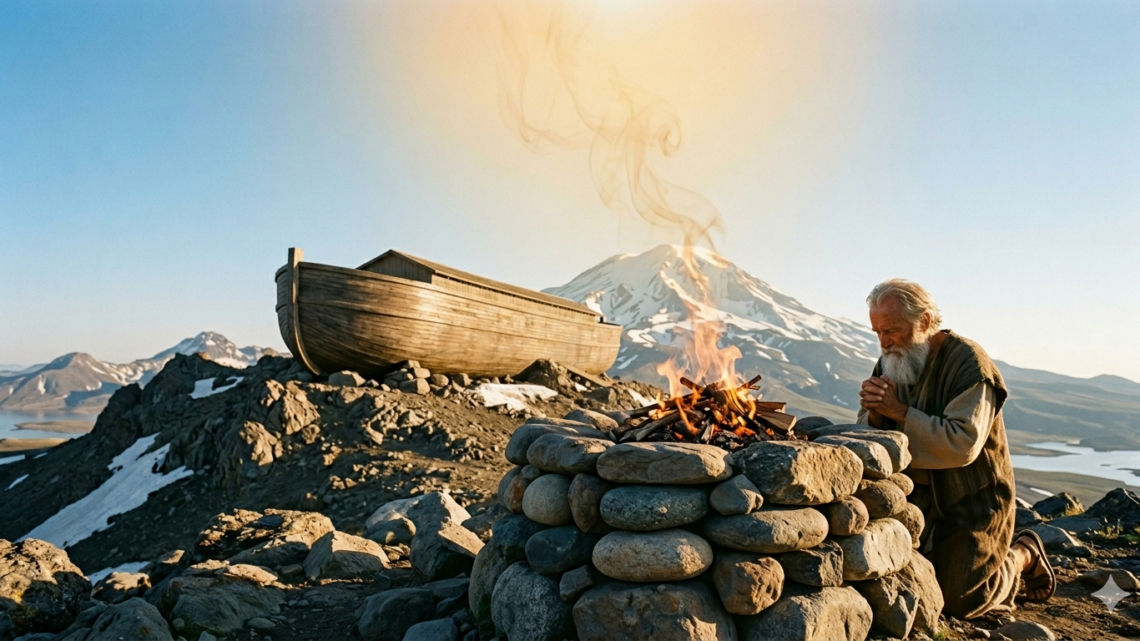
Preserved through the Flood, and now liberated from the Ark, Noah decided to celebrate, to give thanks to his Creator and Deliverer. Genesis tells us, “Then Noah built an altar to the Lord, and took some of every kind of clean animal and some of every clean bird and offered burnt offerings on the altar. The Lord smelled the soothing aroma.” Genesis 8:20-21 (NASB).
The Hebrew literally says, “The Lord smelled the aroma of rest.” On the seventh day of Creation Week, the Lord “rested from the work that He had made.” With the earth now cleansed and life reestablished, and Noah “calling upon” His name, God found rest from the terrible work of the Flood.
“And the Lord said to Himself, “I will never again curse the ground on account of man, for the intent of man’s heart is evil from his youth; and I will never again destroy every living thing, as I have done.
While the earth remains,
Seedtime and harvest,
Cold and heat,
Summer and winter,
And day and night
Shall not cease.”
Not only did God declare that He would never again curse the ground, He also announced the restoration of order to the earth. Seedtime, harvest, summer, winter, day and night—the orderly succession of time itself ensured. Chaos and disorder had been held at bay. With this accomplished, the Ark, the man named “rest,” and God Himself all experienced rest. And it was good.
But humankind still held traces of the virus of sin. So this, too, will pass.