













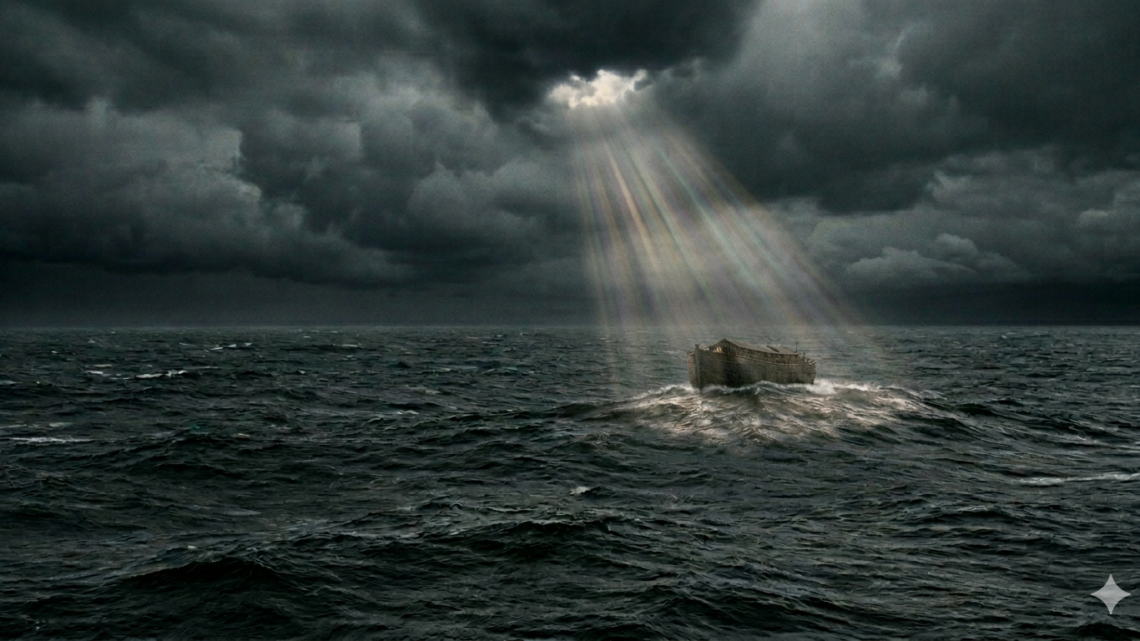
Eight souls. Adrift on an endless sea. Water had surged up from the depths, and fallen from the sky forty days and forty nights, submerging everything. And then, nothing. For 150 days. Five months. Nothing.
The world they had known drowned, vanished. No port to welcome them, no haven to shelter them—only water. Beyond that more water, and after that, still more water. It required faith to build a boat with no great water nearby. Faith to predict water from the sky, when none before had ever fallen. Faith to face the turbulent storm for forty days and nights. Yet all that paled before 150 days of nothing. Then:
God remembered Noah. Not that God had forgotten, as if He could forget—He “caused a wind to pass over the earth,” and the water began to subside. He let the eight know they had not been forgotten. How so?
Hebrew uses the word “ruah” for wind. But it also means “breath,” and “spirit.” An ancient reader saw all three. Look at what that means: God caused a wind, a breath, a spirit to pass over the earth. The text tells us how the wind functioned. But the ancient reader also sees God’s breath, God’s spirit. And hears echoes of Creation. The “wind passing over the earth,” at this place in the story an earth covered in water. Change wind into spirit passing over the water, and we’re back at the formless and void of the beginning.
And God’s breath? Above all the multitude drowned by the water, the eight living humans hear an echo of God giving the breath of life to humankind.
God remembered Noah. The ancient reader hears the depth of that remembrance. The breath tells them God remembered the race whom He had given the kiss of life, remembered that He had created them. The spirit reassures them that God remembered they were alone on an endless sea, and that His creative power will be exercised on their behalf. The wind gives them tangible proof that the vast sea will not be truly endless: that dry land would appear again, that life would resume, that Lamech’s world was gone, and would not return.
Yet something remained that “all the Flood’s great ocean,” could not wash away. The biblical author does not declare it, he demonstrates it. After the rains stopped, Noah sent out a Raven, which “flew here and there until the water was dried up from the earth.” Since the narrative later reveals that drying did not finish until more than eleven months would pass, what does this tell us? How did the Raven survive?
Then we’re told that Noah sent out a dove, but the dove found no “no resting place for the sole of its foot, so it returned to him in the ark, for the water was on the surface of all the earth.”
Two birds sent out. Only one returns. Telling them one immediately after the other, the author wants to tell us something. But what? How will we recognize it?