













Sabbath School Lesson for June 27-July 3, 2026
Introduction to Lesson 1, Paul’s Ministry at Corinth
Memory Text: “One night the Lord said to Paul in a vision, ‘Do not be afraid, but speak out and do not be silent; for I am with you, and no one will lay a hand on you to harm you, for there are many in this city who are my people.’ ” Acts 18:9, 10 NRSV
God came to Paul in a vision and reassured him that there were many of His people in the city of Corinth. The same holds true for us. God will be with us, protecting us from those who might do us harm in the last days. There are still many longing to know more about our God.
The Corinthian church dealt with many of the same problems we experience today in our secular, divided, immoral society. Every Christian church in every denomination has problems of one kind or another that at times seem insurmountable.
The two letters we have available that Paul wrote to the Christians in Corinth (and there’s cause to believe there may have been one or two more) contain core beliefs that helped the Corinthians navigate their problems. These truths have the potential to do the same for us. Paul’s determination to remember Christ and Him crucified is especially something we can cling to and hold fast (1 Corinthians 2:2).
This week, we will explore:
- Sunday: Paul, a God-called Apostle of Jesus
- Monday: From Athens to Corinth
- Tuesday: The City of Corinth
- Wednesday: “Many in This City”
- Thursday: Paul’s Letters to the Corinthians
Sunday: Paul, a God-called Apostle of Jesus
The method of connecting with people in Paul’s day was different than in our world of electronic communication (phone calls, texts, emails, and social media). But at the beginning of Paul’s letters to the Corinthians, we see a similar need for first identifying who we are.
Paul announced at the beginning of both his epistles to the Corinthians that he was an apostle of Jesus, one who was called and sent out to do the will of God. He also identified himself in some of his epistles as a servant of Christ, a preacher and a teacher. Christ maintained a position front and center in all Paul attempted to do and say.
What we need to remember is that we each have a calling as well. God is anxious to convey His wishes for our lives, just like He did for Paul. We can all be followers of Jesus and serve Him in many and diverse ways.
Verses for reflection and discussion:
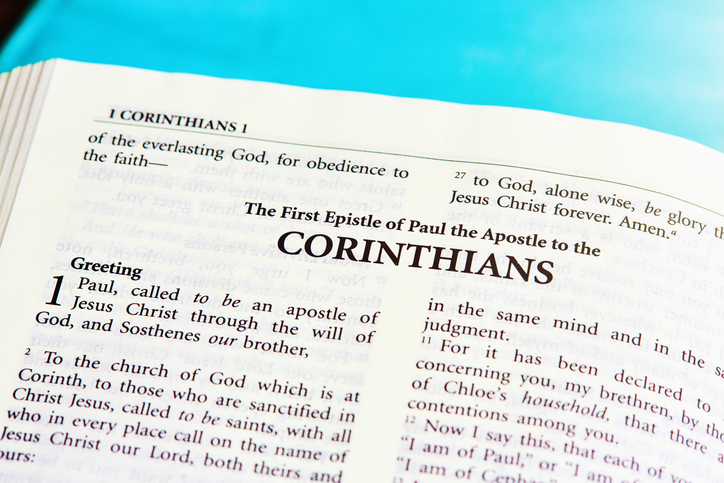
1 Corinthians 1:1, Galatians 1:1 and Romans 1:1
- How does Paul identify himself at the beginning of these epistles?
- What kind of work has God chosen for you–what do you feel is your calling?
Monday: From Athens to Corinth
It’s helpful to know what brought Paul to Corinth. The book of Acts, recorded by Luke, reveals that Paul and his friends had experienced opposition in Berea, causing Paul to remove himself and flee to Athens. In Athens, while waiting for his missionary friends Timothy and Silas to join him, Paul was able to share the gospel in the marketplace in Athens and even to philosophers who met in the open theatre called the Areopagus.
Sensing there was significant work for their team in a metropolitan place like Athens, Paul felt impressed to go to the similar bustling trade city of Corinth, where he continued to wait for his faithful team of Silas and Timothy to catch up with him. Staying and working with Priscilla and Aquila, two Jewish tentmakers, Paul, a tentmaker himself, began his work in the vast port city of Corinth.
Once again, Paul began his preaching there in the Jewish synagogue, since Jesus had indicated that the work should go first to the Jews, and then to the Gentiles. That strategy had worked quite effectively so far for Paul’s team, so it made sense to continue the practice.
Verses for reflection and discussion:
Acts 17:16-34
- Why is it helpful to know about Paul’s stay in Athens, just before he went to Corinth to preach the gospel?
- How did Athens prepare him for the work in Corinth?
Acts 18:1-11
- What seemed to make Paul’s efforts in Corinth effective?
- What does his working as a tentmaker tell us about missionary work that we might be called to do?
Tuesday: The City of Corinth
Corinth, an economically-advantaged metropolis and rival of Athens, was fortunate to have two harbors that encouraged the trade of goods and ideas. It had thus become a very pluralistic city, where many religious shrines and idolatrous practices thrived. Ritual prostitution, encouraged by many of these religions, also had a home there, causing its citizens to have lowered sexual standards than other places where Paul could have gone.
Paul recognized, however, that if the faith took root in Corinth, it would likely find its way to other locations in that part of the world. Understanding what worked best for Paul with the difficult challenges he faced in Corinth will therefore inform and encourage us as we struggle to make inroads in the many large cities of our world today.
Ignoring large cities is probably not the best way to conduct missionary work. Cities contain our most needy populations who deserve to hear the gospel as much as anyone. Let’s not neglect them, overlooking perhaps our most effective way to have the truth go out from their borders to others who are thirsting to know the true God.
Verses for reflection and discussion:
Acts 18:1-3 and 1 Corinthians 5:9-11, 8:4
- How would you describe the economy, morality, and religious life in the city of Corinth?
- Why did Paul likely choose such a difficult population to work with, and how should this impact where we go to conduct evangelism today?
Wednesday: “Many in This City”
His initial work with the Jews of Corinth was not promising. There were many Jews who rejected Paul’s message about the Messiah. It said in Acts 18:6 that they “opposed him and blasphemed”. In other words, they did all they could to damage Paul’s reputation and cause his words to be ignored. It became so uncomfortable in the synagogue that Paul determined it was time to reach out more to the Gentiles in the city.
His work with the Jews was not in vain, however. Surprisingly, Crispus, the ruler of the synagogue, along with his whole family, accepted Jesus as the Messiah.
Despite strong opposition, the Spirit of Jesus remained with Paul as he preached fervently in the difficult city of Corinth. This gives us confidence that God will not leave or forsake us either. Just as Isaiah was told, “Fear not, for I am with you”, we can be assured that God’s Spirit will be by our side even when things look dark and unpromising.
Verses for reflection and discussion:
Acts 18:4-8
- Why was it encouraging for Paul’s team to have both a Jew and a Gentile as their first converts in the city?
- What may have contributed to Justus’ conversion?
Acts18:9, 10
- Why was it beneficial and even necessary for God to speak these words to Paul in a vision? How might it have impacted their further evangelism in the city?
Thursday: Paul’s Letters to the Corinthians
The many struggles going on in Corinth were brought to Paul’s attention by a wealthy, Christian businesswoman named Chloe (1 Corinthians 1:11). It’s unclear whether she was from Corinth or Ephesus, but she and her associates likely traveled much between the two trade centers, across the Aegean Sea from each other. In any event, Paul learned the specifics of the trials and difficulties of the Corinthians through her and felt impressed to address them in his epistles.
The first letter we have to the church in Corinth is “one of the richest, most instructive, most powerful of all his letters”, according to The Acts of the Apostles, p. 301, by Ellen G. White.
In the first six chapters, Paul calls out specifically what their issues and problems were, perhaps to help them see themselves more clearly, or to just let them know that their struggles hadn’t gone unnoticed. We know how Paul loved their congregation. It says in 2 Corinthians 2:4 that he was grieved to the point of tears because of them.
The remainder of his first epistle contains answers to the many questions they had raised concerning marriage, divorce, celibacy, worship practices, spiritual gifts, and Christ’s resurrection.
Verses for reflection and discussion:
1 Corinthians 1:11, 16:9
- Where was Paul when Chloe came to him with a report about the Corinthians?
- How would “the household of Chloe” indicate that she was a woman of wealth and influence?
Friday: Final Thoughts
It’s important to recognize the historical and cultural background of the city of Corinth to fully appreciate what Paul accomplished there. His mission to spread the gospel to the Gentiles, guided by the Holy Spirit, included this very strategic city, which was much like the large metropolitan areas in the world today.
Learning from his stay in Athens, Paul was determined to avoid arguments and debates, and “not to know anything” among the Corinthians except “Christ, and Him crucified” (1 Corinthians 2:2). Laboring there for a year and and half, Corinth became headquarters from where the work branched out to many other towns and cities.
There seems to be an emphasis on identity in his letters to the Corinthians. Paul established his own identity, but also encouraged them to examine their own, and ways they could improve their witness to others by making good choices based on appreciation for Christ had done for them.
Next Week: The Message of the Cross
To read the Sabbath School Lesson Quarterly and see more resources for its study, go to
