















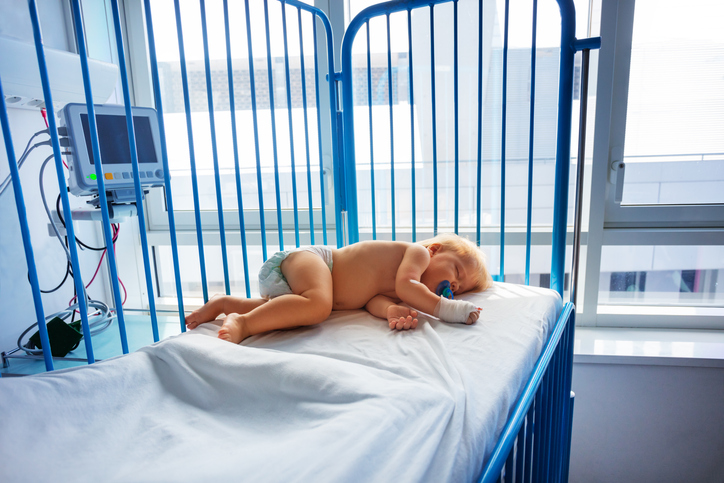
Rick’s whole first year, our mother put her hand through the crib slats on his chest, becoming a human apnea monitor through every night.
After his first birthday, we shared a room, with a door to my parents’ room so they would hear if anything went wrong in the night. Both of us were just a few feet from our parents bed. Nobody told me to watch. Whenever I was awake, I would lie still, and watch for his chest to rise. If it didn’t rise fast enough to suit me, I tiptoed over to put my hand through the crib slats and feel for breathing.
He was always breathing. I checked anyway. Every time.
The night it happened, I couldn’t fall asleep. Unusual for me. I heard him making a sound he didn’t usually make. He had never kept me awake before.
I waited what seemed forever for it to stop. Then I got up, went through the open door, climbed into bed with our father, and told him Rick was making noises and keeping me awake.
He was at the crib immediately. Then he was at the basement door, calling down to our mother — this kid is breathing funny. She came running up the stairs.
They carried him to the kitchen table. My father’s whole body had gone tense. My mother stood with her elbows braced on the table and her head in her hands. My adult sister, Elaine, was standing at the table too as she was temporarily staying with us as her husband had been drafted.
I stood back, in the doorway. I did not understand what I was seeing. I knew it was bad.
I did not cry.
They had not seen a seizure before.
Our mother called the doctor on the rotary telephone in the kitchen. It was a party line, so likely the neighbors were listening in on the drama.
I was not brave and I was not clever. I reported a complaint. He was making noise. I could not sleep.
I had been on duty already. That is what hypervigilance looks like when it works, and it did work. He was seizing. I heard it.
And here is what I only understood as an adult…
My parents did not know what they were looking at either.
Rick had seized once before, on the first day of his life, and he had been on medication ever since. Neither of my parents had ever seen a seizure — he had been in the hospital nursery when it happened. My mother on the telephone in the corner of the kitchen was asking a doctor to tell her what was happening to her son, and what to do.
I could not have put that into words at five, but I understood it in my body anyway. That is where children understand things first. The adults did not know. That is its own particular terror.
I never did cry. Not that night, not afterward.
I have gone looking for the feeling and there is nothing there — no fear, no memory of wanting to be held, reassured. What I have instead is the map of the room. Who was nearest to him. Where the telephone was. How far away I was standing.
I was not calm. I was five years old with nowhere to put what I had just seen. But from across a kitchen there is no telling the difference between a child at peace and a child who is silently frightened, paralyzed even. I looked like a good little girl who was no trouble at all on a very hard night.
And a child who does not cry does not get asked.
Lord, You know what we could not say and did not cry. Nothing we carried in silence was ever hidden from You. Give us words now, and someone safe to say them to. Amen.
Next time: what my family did with that night and afterward, and the difference between being praised and being asked.
Click here to see the first in this series. Click here for Part 3.