













In September 2019, a Category 5 hurricane slammed into the Bahamas. With winds exceeding 185 miles per hour and storm surges reaching up to 23 feet, Hurricane Dorian was one of the most powerful storms ever to make landfall in the Atlantic and the worst natural disaster in the history of the island nation. As a career marine in the Royal Bahamas Defence Force (RBDF), Jamie Rahming was part of his government’s humanitarian response in the wake of the storm. Working alongside teams from the U.S., U.K. and other nations, he felt a calling: a new way he could serve his country.
“Hurricane Dorian devastated our two northernmost islands,” Rahming said. “We did pretty well with what we had, but we needed so much help from other countries. After that, I started looking at how I could enhance our ability to respond to disasters.”
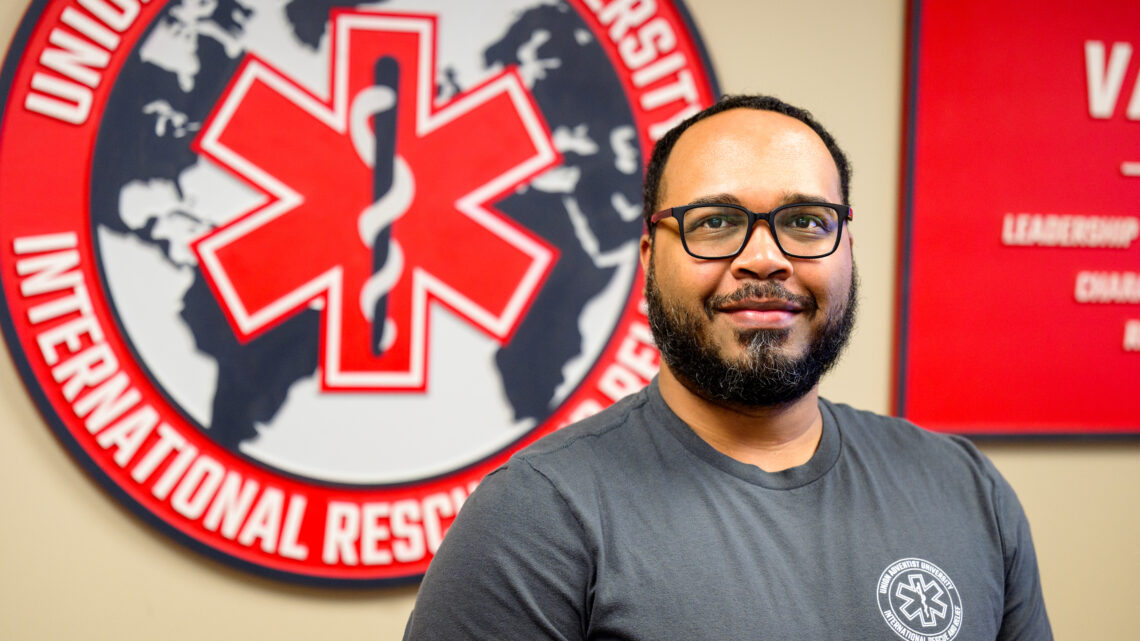
He had seen firsthand that the Bahamas needed professional search-and-rescue teams on the same level as those coming from other countries. He and his wife began searching for a program that would train him to lead such a team, and they found Union Adventist University’s International Rescue and Relief Program listed on the FEMA website. “It just so happens that at the time Union had the only hands-on program dealing with disaster management,” he said. “I thought, This is going to work for me because I prefer hands-on learning instead of just book work. So that’s how I ended up choosing Union out of all the schools on the list.”
He wrote a proposal to develop a search-and-rescue team. It was sent up the chain of command, and in 2022, Rahming was granted study leave from the military. The full support of the RBDF gave him the financial freedom to bring his family to the U.S. while he earned his bachelor’s degree at Union.
“My proposal is to start an urban search-and-rescue team with an emphasis on rope rescue, floodwater rescue, confined spaces, wildland firefighting, missing persons … all the things that we need back home,” Rahming said. “We would have that base of skills within that department, and from there we can build teams that not only assist in the Bahamas but also help other Caribbean countries when disasters strike.”
Fortitude and support yields multiple certifications and opportunities
When Rahming arrived in Nebraska, it was the farthest he had ever been from home—and the farthest north. “To come all the way to Nebraska, I thought, This is going to take some mental fortitude,” he said. “Even though I didn’t know anyone here, I knew I could do it. And then the winter came. The weather changes 20 degrees one day, and then the next day there’s another 20-degree difference. This is like nothing at home.”
Despite the cold weather, he found a warm welcome at Union Adventist University. “I love this place,” he said. “It’s a close-knit community, so the professors are more involved in helping you succeed. It’s been very beneficial in helping me work toward my goals.”
When asked what advice he would give a new student considering Union’s IRR Program, Rahming said, “Come prepared. Prepared for what? The weather. Long nights of studying. Time management. It’s not going to be easy, but because of the way Union is set up, you always have a community that will help you. Come prepared to ask for help.”
In addition to earning his baccalaureate degree at Union, his four years in the IRR Program mean he is now certified in emergency medicine, search and rescue, swiftwater rescue and flood management, technical rope rescue, wilderness medicine … and more. In fact, he has not only earned the certifications but has also worked as a teaching assistant training others. As part of the university’s disaster response team, he deployed to Arkansas, Florida and North Carolina following natural disasters, putting his training into practice in situations very similar to the hurricane response that started him on this journey.
Rahming reached out to Nebraska Task Force One for guidance on how to set up a similar response unit back in the Bahamas, and he has been grateful for the opportunity to learn from one of the top urban search-and-rescue teams in the United States right here in Lincoln.
Having graduated from Union in May, Rahming is now heading home. He says his next step is either officer training or a master’s degree in disaster management. “If one doesn’t work out, I’ll do the other. Hopefully they both work out, and hopefully there’s no hurricane soon. Let me get the team together first.”
