














The flood cleansed the violent culture. That was the symptom. The disease remained, which Noah demonstrated in a surprising way not long after leaving the ark.
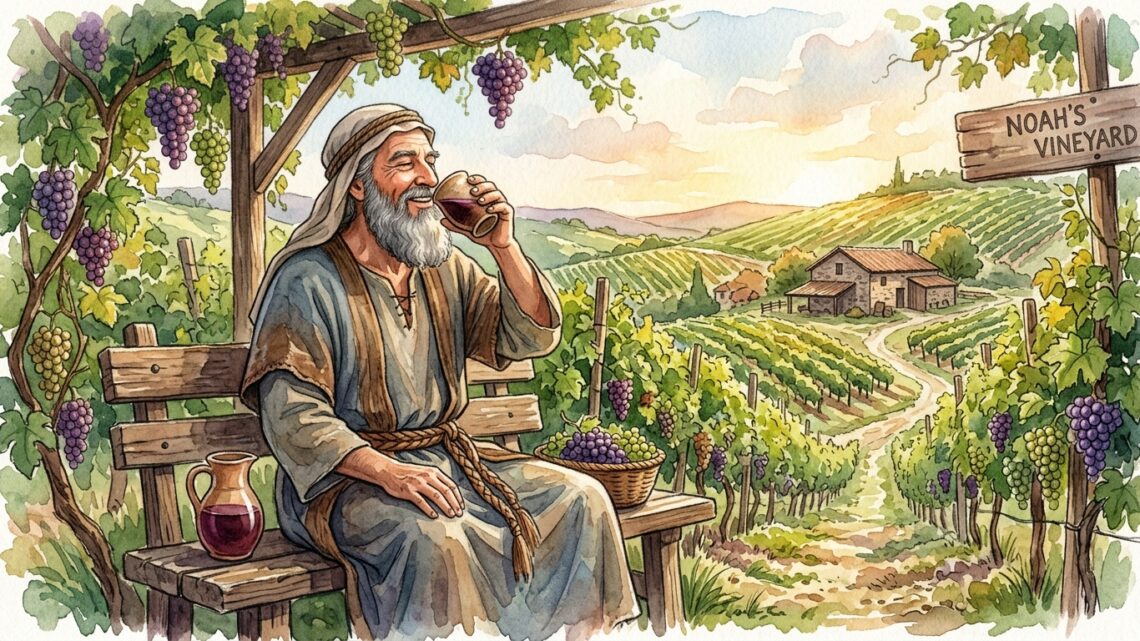
We’re told he planted a vineyard. Nothing unusual about that. But we’ve seen a man in a garden before in Genesis. Adam had a garden.
And the Noah story mirrors—reflects, not duplicates—the garden story closely. Adam ate the fruit of a tree and brought sin into the world. In this story, Noah drinks from the fruit of the vine and demonstrates that sin survived the flood—and not just in some, but in all.
The Flood had left a clean world, a renewed creation, the rainbow as both memorial and promise. But Noah’s sin in his vineyard served as reminder and warning.
Yet like most such parallels in scripture, it both repeats and breaks the pattern. The repeat is clear, the break more subtle. After eating the forbidden fruit, Adam immediately recognized his nakedness and he hid himself in shame. But here the pattern breaks, and the story takes a strange turn.
Noah’s nakedness results from drunkenness, and he sleeps—unaware of anything at all — his own body, his own tent, his own exposure. Adam had hid himself, but one of Noah’s son walks in, sees his father exposed — and instead of covering him, announces it. The other two do the opposite: they walk in backward, a garment held between them, and cover Noah without looking at him at all. When Noah wakes and learns what happened, judgment falls — but not on the son who saw and told. It falls on that son’s own son, Canaan.
Adam’s fall ends in a covering. Fig leaves first — his own inadequate effort — and then God himself provides one, animal skins, a covering that could only come by way of a death. Something else paid so Adam could be covered.
Noah’s fall ends in a covering too. Two sons, walking backward, a garment held between them. But this time the covering is only human effort — no death stands behind it, no provision follows it. And where Adam’s story closes with mercy meeting inadequacy, Noah’s closes with judgment reaching forward instead, onto a grandson who wasn’t even in the tent.
The original Fall in Genesis 3’s curse didn’t stop with Adam and Eve. It reached forward — into the pain of childbirth every mother after Eve would carry, into the thorns every field after Eden would grow. And Genesis 4 shows us exactly how far that reach goes, when the very next generation produces a murder. The penalty for sin never stays contained to the one who sinned. Without divine intervention, it moves inexorably forward, from one generation to another, sin without end.
Noah’s story runs the same mechanic in miniature. One man’s failure, and the judgment lands a generation down the line.
So here’s where that leaves the flood. The waters came, drowned the violence, handed back a new world — animals repopulating it, a rainbow marking the promise, everything re-created. And within a chapter, the one man God spared to carry it all forward is lying exposed in his own tent, and the consequences are already reaching for his grandchildren.
The flood could wash away a corrupt culture and give the world a cleaner slate. It preserved a man who called upon the name of the Lord, but who still carried the deadly taint of sin. The poisonous seed of the fruit Adam ate still grew within mankind. And it would spread again. Quickly.