












God had preserved humankind and all life in the Ark. He had washed away the people, like Lamech, who trusted only in themselves, and preserved those who trusted Him, and called upon His name. But preserving humankind involved more than their physical presence. It also involved their free will.
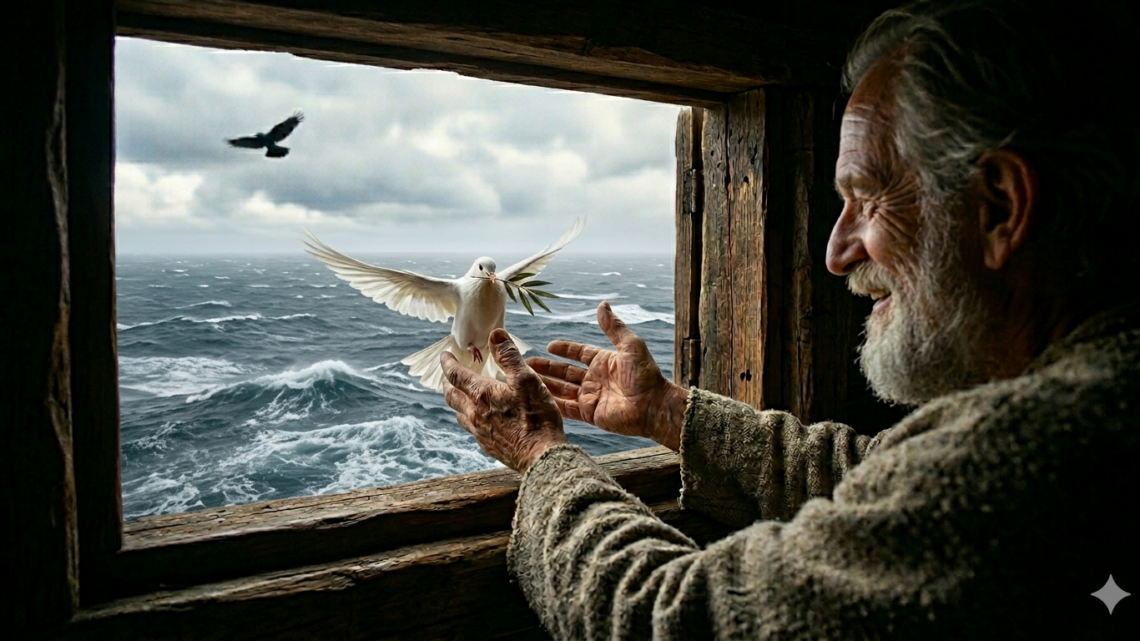
When Noah released the Raven the story implies it somehow survived even while the land remained submerged. The Raven “flew here and there until the water was dried up from the earth.” Ravens are scavengers, living on carrion, the flesh of dead animals. With so many animals drowned, no doubt he found sufficient floating carcasses to feed on.
In many ways, this signals the cleanup of the festering remnants of the pre-flood culture—making a “cleaned slate” of the natural world.
Quickly after releasing the Raven, Noah released a Dove, which found “no resting place for the sole of its foot, so it returned to him in the ark, for the water was on the surface of all the earth.”
The ancient reader saw in the dove flying over the floodwaters and finding no resting place an echo of the spirit hovering over the chaotic waters of Genesis 1. Re-Creation has begun. The first one took seven days. How long will this one take?
Seven days later, Noah sends out a dove again. This time it returns with an olive leaf. The text tells us that Noah knew the water was low on the earth. Of course, plant life can function quite well on muddy and swampy land. Animal life needs something more substantial. So did the dove, since it returned. God created plant life on day 3 of creation week, the same day that dry land appeared. So Re-Creation has advanced that far.
The dove returning with any leaf would have signaled the return of dry land and new growth of vegetation. But the author identifies it specifically as an olive leaf. Olive trees played a vital role in the ancient world. They provided oil, which humans used for anointing, food, and light. The trees grow slowly and —we now know—can endure for thousands of years. So the ancients regarded the olive tree as a symbol of peace, fertility, prosperity, and even divine favor.
The return of the dove with the olive leaf brings more than evidence of the retreating waters and the renewal of plant life. The olive leaf announces more than just God’s activity in renewing and restoring order to the sin and flood ravaged planet. It brings a message of hope and assurance of divine favor.
Yes, God remembered Noah, and saved him from the chaos of the former violent world, and the raging waters of the Flood. And God continued to remember Noah, assuring him that a restored world is possible. The flood visited upon men the chaos and disorder they had chosen. In that sense, the Flood served as judgment.
But the return of plant life, specifically of the olive tree, demonstrated that the act of divine judgment was also deliverance for those who had chosen to call upon the name of the Lord. Deliverance from the terrifying world where men’s thoughts were only evil continually; deliverance through the cleansing flood of judgment. And now the hope that humanity might again live in peace.
That’s where the next passage will take us.