













In 2026 I will be exploring early Sabbatarian Adventists in the states that now comprise the Mid-America Union. There is no way to know who the first Millerite or Adventist was in each state. Instead, I will feature the first people to write to the Advent Review and Sabbath Herald (forerunner of the Adventist Review) from the territories or states in what is now the Mid-America Union.
Olatha, Nebraska, truly is a ghost town. So thoroughly wiped from map and memory, some people confuse it with Olathe, Kansas. In 1858 there really was a town named Olatha, Nebraska, near present-day Roca, south of Lincoln (The First Settlers in Lancaster County).*
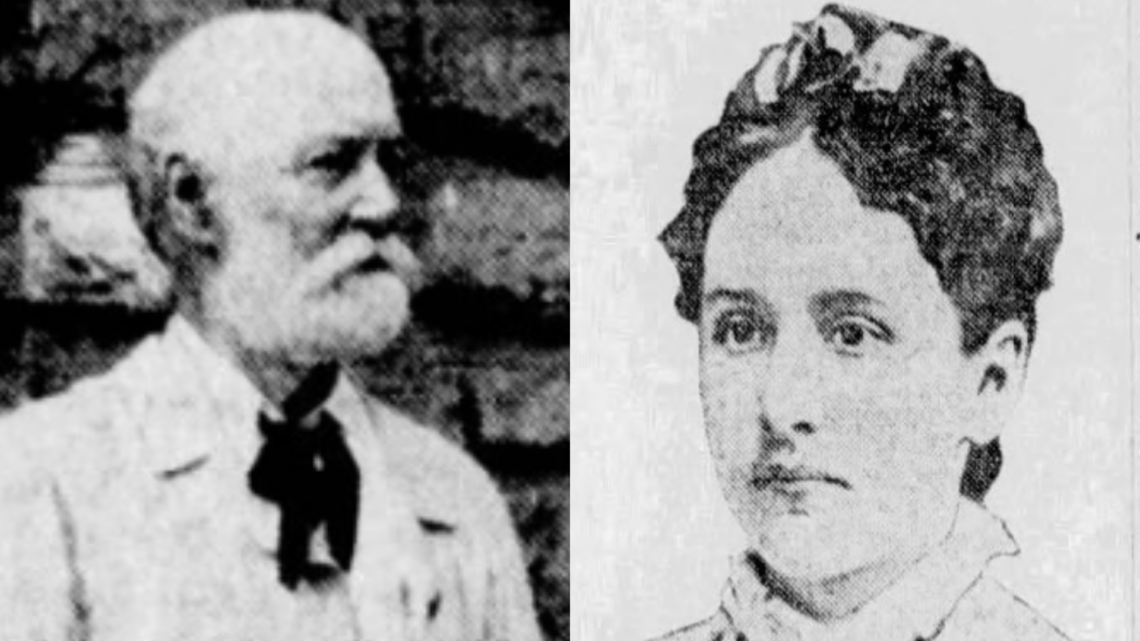
The first seventh-day Sabbath-observing Adventists in Nebraska Territory (and also among the first settlers of Lancaster County, Nebraska) were Joseph Van Rensselaer Weeks and his wife, Imogene Cookson Weeks. Joseph was born in New York State, probably near Sheridan in the western part of the state, in 1821. His father, Russell Weeks, was a strict minister. Joseph described his childhood as:
Reared amid strong sectarian prejudices, taught to believe in and practice the observance of the first day of the week as the Sabbath, I regarded Commandment-keepers as rabid sectarians, willfully adhering to a Jewish institution, merely for the sake of notoriety… (Advent Review and Sabbath Herald)
Imogene Cookson was also born in New York State in 1821. Joseph and Imogene married in 1842. Two children were born to them in New York, George Russell (1843-1844) and Mary Josephine (1845-1880). By the time of Francelia (Celia) Georgiana’s birth in 1848 (died 1939), the family had moved to Trenton, Dodge County, Wisconsin, where they settled on a farm. Their son Edwin later claimed the family lived in Fairfield (Washington County, so they may have moved within Wisconsin). Three more children were born in Wisconsin: Ella Evalina (1850-1927), Leslie Albert (1852-1856), and Edwin Ruthven (1855-1938). The youngest child, Raymond (1863-1954) was born in Iowa after their short Nebraska sojourn.
The Free-Soiler Weeks family moved to Olatha, Nebraska, in 1856 or 1857, soon after the passage of the Kansas-Nebraska Act of 1854. There is no indication of when or where Imogene encountered Adventist publications. She began keeping the Sabbath in mid-1857. Her husband was more resistant and did not accept the seventh-day Sabbath until January 1858. When he finally did so, he was most fervent.
…but thanks to God, the mists of Popish darkness are breaking away and light bursts in bringing peace, joy, patience, self-denial, love unbounded, an earnest longing for immortality and the appearing of our Lord Jesus Christ. (Advent Review and Sabbath Herald)
It was a lonely faith with no other Adventist believers near them, and their neighbors disagreeing with their peculiar belief.
We are the only family in this region that regard the fourth command as not being Jewish, but of universal application, binding on man wherever he may be; yet we have reason to believe that the truth is beginning to find its way through every refuge of lies, and would soon be potent to the pulling down of the strong holds of Satan, could we have the Review, accompanied by some standard Sabbath and Advent publications, to aid in its propagation and more general diffusion. (Advent Review and Sabbath Herald)
The Review and Herald Publishing Association sent Weeks a quantity of books valued at 50 cents (about $20 in 2026).
Evidently the Weeks’ found farming in Nebraska no more satisfying than Wisconsin. By 1860, they had moved again, this time to Benton Township in Fremont County, Iowa, about sixty miles east of Olatha, Nebraska. Or perhaps they had another reason for moving. Joseph took up masonry work, apparently in the new village of Civil Bend as Advent Review and Sabbath Herald readers heard from him in August with a letter posted from Civil Bend. Four years later, he again wrote to the Review, this time from Tabor, Iowa, just a few miles east of Civil Bend. This is where the story gleaned from the Review ends.
An Alternate Narrative
The obituaries of Joseph’s children tell a somewhat different story. First of all, readers need to know something about Civil Bend that provides insight as to why Joseph Weeks would have wanted to move there.
First settled by abolitionist in 1847 and perched on the flood plain next to the Missouri River, Civil Bend was not destined to survive. However, by 1857 the village was acknowledged as the western terminus of the Underground Railroad (although Nebraska City and Falls City on the western side of the Missouri River also played a role). Freedom seekers from Missouri, Kansas, and Nebraska as well as points further south, found their way to Civil Bend, from which they were transported up the bluffs to Tabor (founded in 1852 on tableland above the flood plain) and then to Chicago and beyond. (See Iowa Freedom Trail Project and Tabor Historical Society)
According to his son Edwin’s obituary (Kansas City Times, August 18, 1938), Joseph’s Iowa farm (was masonry a temporary job or in addition to farming?) was an Underground Railroad station. Contemporary evidence is circumstantial. Edwin was five years old when his family moved to Iowa. He was an infant when they moved to Nebraska. The stories told about his father in newspaper articles in the 1920s and 1930s contain enough discrepancies to make one cautious.
Edwin’s obituary also claims that his parents’ ultimate goal when they left New York had been to settle in Kansas. This seems unlikely. New Yorkers heading west in the 1840s were looking for cheap land and space to expand. Kansas was not yet an organized territory, while Wisconsin offered both inexpensive land and an established community on the cusp of statehood. Much more attractive for a young family.
In 1856-1857 Kansas was bloodied by fighting between proslavery “border ruffians” from Missouri and anti-slavery free-state settlers. Joseph may have wished to support the bid to keep Kansas free of slavery, but Nebraska may have appeared safer for his family.
Joseph and Imogene finally settled in the Kansas City area in 1865. In Westport, Missouri, (now a neighborhood in Kansas City) Joseph, disturbed by the lack of educational institutions accepting freedman, established a school in a log cabin on his property in 1866. His sixteen-year-old daughter, Ella, taught the school for a year without pay before the local school board decided to provide a facility (Kansas City Star, October 7, 1927).
As Joseph and Imogene aged, none of their children seem to have accepted the Seventh-day Adventist message. In Edwin’s case the ridicule of his childhood peers may have been a deterrent. Ten years old when the family arrived in Westport, he was teased about his mother’s “Bloomer costume,” his father’s Seventh-day Adventist beliefs (allegedly Joseph was an Adventist minister, but there is no evidence in denominational publications), and his father’s support of freedmen. Post-Civil War Missouri was still a bitterly divided place.
Joseph and Imogene remained faithful to their beliefs while also remaining close to their children. Their daughters married and scattered. Raymond moved to the eastern states and became a university professor. Edwin remained in Kansas City, Missouri, where he became a businessman of some note, leading the electrification of the city and founding Great Plains Energy in 1882. The last record available indicates that Joseph worked as a plasterer in his later years.
Joseph Van Rensselaer Weeks died in 1874. Imogene Cookson Weeks died in 1879. They are buried in the Elmwood Cemetery in Kansas City.
*I use the spelling “Olatha” for the place name in Nebraska in this article because that is how it is spelled in the Advent Review and Sabbath Herald. However, other sources do use “Olathe” in reference to the Nebraska location.
