














At the end of the last post I made a claim, and I owe you the proof. I said Genesis 11’s genealogy answers the question Babel leaves hanging: What is God going to do now? And I said the answer is Abram.
How do we know that’s the author’s answer, and not just mine?
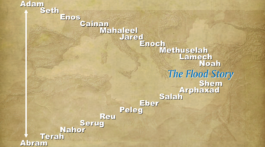
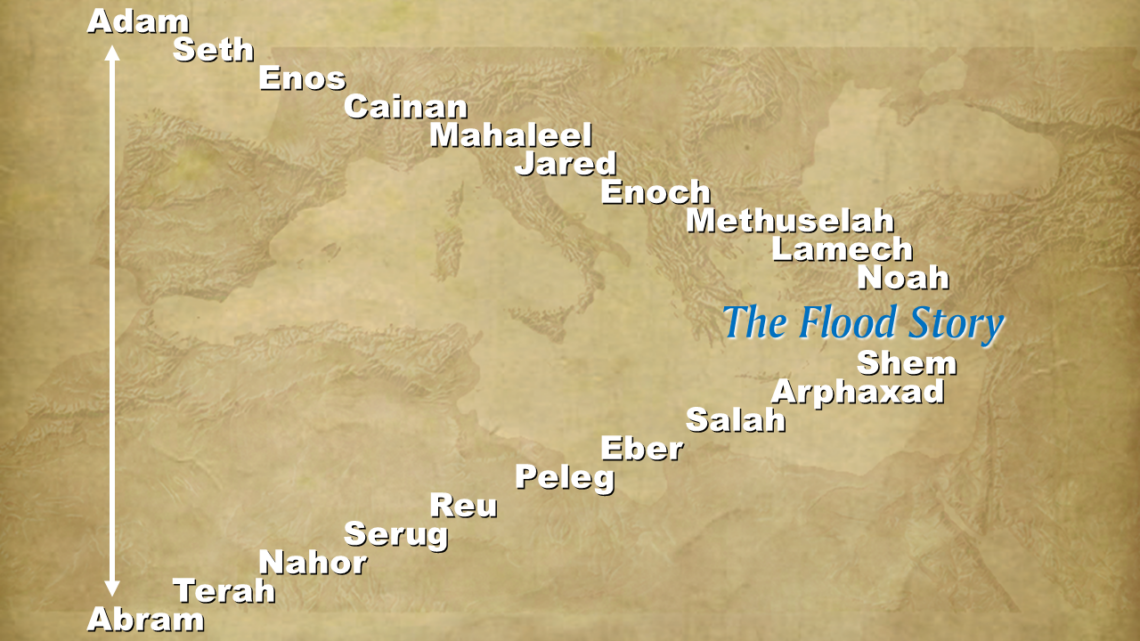
Because of the way he built the two genealogies. Lay them side by side, and a shape emerges.
Two chains, one event. Genesis 5 runs ten generations from Adam to Noah. Genesis 11 runs ten generations from Shem to Abram. Of all the genealogies in Genesis, these are the only two that carry ages. And both are fastened to the flood. Noah was 600 years old when the flood began. Shem was 100 years old when he fathered Arpachshad, two years after the flood. One age counts into the event, the other counts out of it.
Same length. Same unusual feature, ages. Same event hinging them from opposite sides. Things like that don’t happen by accident.
What the shape is. Hebrew writers had a favorite structure for this, called a chiasm. The word comes from the Greek letter chi, shaped like an X, and the idea is simple: a mirror. The first element answers the last. The second answers the next-to-last. On and on inward until you reach the middle, and the middle is the point. Everything else is arranged around it so you can’t miss it.
If these two genealogies form a chiasm, the center is the flood. Noah at the end of one, Shem at the beginning of the other, and between them the flood story itself.
The mirrors, one at a time.
The center. Noah is 600 when the flood comes. That’s the age at which the old world dies. Now look at Shem: his entire life comes to 600 years. The number that marks the death of the old world on one side of the flood reappears on the other side as the full measure of the man who carries the line through it.
The three sons. Noah lives 500 years and then fathers three sons at once, Shem, Ham, and Japheth, and, as we saw, Shem is listed first without being the firstborn. Now go to the end of the second genealogy. Terah lives 70 years and fathers three sons at once: Abram, Nahor, and Haran. Abram is listed first, and we know from elsewhere in Genesis he wasn’t the firstborn either. Same unexpected move, same reason: the one listed first is the one the story follows. Shem anchors the next genealogy. Abram anchors the rest of Genesis.
The ends. The first element of the first genealogy has to mirror the last element of the last. The first is Adam. The last is Abram.
That’s the one that rewards a second look.
The new Adam, with a difference. Adam is the father of the human race. Abram, in this structure, is placed where Adam stood. But notice what the author does not say. He doesn’t make Abram the father of everyone. He can’t: everyone alive after the flood goes back through Noah. So what is Abram?
He’s what Seth was. Remember where we left Seth: the third son we know of, arriving after Cain’s murder of Abel, appointed, as Eve says, in place of Abel. Seth was a son of promise, the one through whom the godly line would continue when everything else had gone wrong. Abram is the same kind of figure, at the other end of the flood. He is not the beginning of humanity. He is the beginning of God’s next move.
And that’s the answer. Put the whole sequence together. Noah was a deliverer, but he delivered humanity through the flood, not out of sin. He walked off the ark and fell in a vineyard. His descendants filled the earth, and then clustered in a city and raised a tower to make a name for themselves. Babel is where the flood story actually ends: the confusion and disorder the waters had brought finally came down on the people who had refused the commission to fill the earth.
So the reader is left with a question that nothing in the flood story can answer. Sin is still here. Noah couldn’t fix it. The flood couldn’t fix it. What is God going to do?
And the author has already told us, in the very structure of his genealogies. The first story after Babel is the story of a man from the end of that second chain, standing where Adam stood.
Abram.
We’ve seen three separate genealogies, and how they tell stories. There’s one we mentioned in the very first post in this series, along with some hints about what might be happening. The one in Matthew. Now that you have the tools, let’s take another look. What story do you think Matthew is telling?