















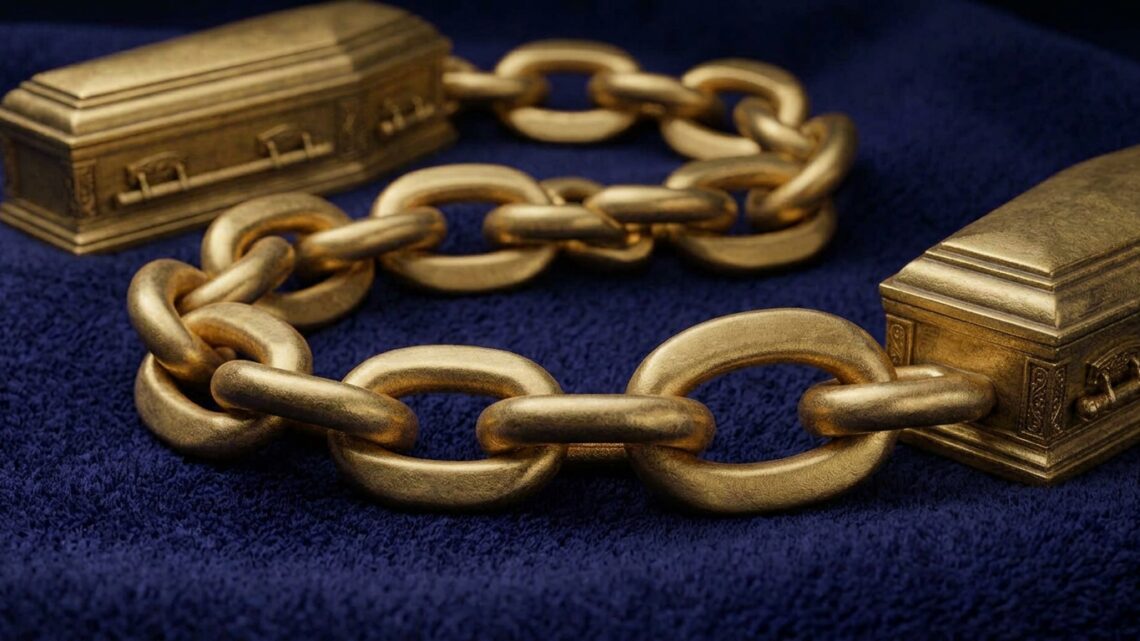
Ten generations, each link connecting to another, and then one link reaches outside the family chain and fastens to an event, the great Flood. But why?
That’s answered by another chain we often overlook. It contains no ages, does not even offer a timeline, to creation or anything else. Instead of ten links, it has only six—kind of. No ages, fewer internal links. It’s a very odd genealogy, not what we are accustomed to, and so we often overlook it. That’s where I stopped paying attention.
Instead of moving on, I should have asked, “Why is this genealogy so different?” Once we recognize that genealogies are a form of story, the answer becomes easier: “Because it’s telling us a different story, even a different kind of story.” And reading to the end of this genealogy, we come to a shocking discovery: both ends of this chain link to murder.
Growing up, the only thing I paid much attention to in Genesis 4 was the murder at the start. We might even call it the start of murder, because the initial verses tell of Cain murdering his brother—the very first murder—his subsequent exile, and the surprising declaration by God that He will protect Cain from reprisal. No one wants to risk becoming the target of that sevenfold vengeance by killing Cain themselves.
The first sixteen verses deal with Cain, his crime, and his punishment. The next two verses name 5 generations, landing on Lamech. The next six verses are all about Lamech, and his “accomplishments.” He took two wives for himself, boasted about killing a young man, and declares that “If Cain is avenged seven times, then Lamech seventy-seven times.” And there it is. This chain ends as it began, in murder.
Twenty-two out of 26 verses focus on two murderers. Everybody else has to settle for four verses, total. The evidence indicates the author intends to emphasize that both ends of this genealogy link to murder
And in chapter six, the author makes plain the results of letting murderers go unpunished. Before the flood comes, the text tells us plainly what the earth had become: “filled with violence.” Not idolatry, not sexual sin— violence. A world where those most inclined to violence killed as they pleased, and ruled over those they let live.
The coming flood of water washes away the culture of violence. Judgment matching crime in kind, not just in severity — those who had drowned the world in blood would drown in a flood of water.
The flood could wash away a violent culture, but without significant change in its operation, human society would degenerate into violence and chaos again. God institutes the first change immediately after the water recedes. For the first time in human history, God commands capital punishment. “Whoever sheds the blood of man, by man shall his blood be shed.”
Humanity had tried the serpent’s way unrestrained: they had tried to be god, to be the arbiter of life and death. Protecting the first murderer, Cain, planted a deadly seed that bore poisonous fruit in the violent society Lamech celebrated. No society can long survive when power is the supreme goal, and murder is its fulfillment. That had been demonstrated. Thus, instituting capital punishment was in fact a blessing. God imposed a limit on the previously unrestrained self, so that others could survive it.
The flood dealt with the most dramatic symptom of following the serpent, but the disease remained. And it will soon be demonstrated by a most surprising person.