














In the first post in this series, I said, “We assume a biblical genealogy works like a pedigree, or a family tree, as a list to be checked rather than a story to be read.” In this series we’ve seen how the genealogy in Genesis 5 tells a story about the lineage that worshiped the Lord, and we know that a matching genealogy—same structure, same number of generations, including ages—will arrive in chapter 11. We have seen that one way a genealogy tells a story is both establishing and breaking a pattern, and that the last link in the Genesis 5 genealogy links not to the next generation—but to the Flood.
And now, just after Noah disembarks from the ark, we encounter another genealogy, one that’s radically different from the other two. It breaks the pattern of the list in Genesis 5, and uses a different pattern entirely. It doesn’t proceed directly from one generation to the next, one son at a time. Instead it starts with Noah’s three sons, and lists their multiple sons, grandsons, and so on. Japheth’s list extends three generations, Ham’s four, and Shem’s six—with the final one listing 13 sons! What’s going on here?
To understand what the author wants to tell us, we always ask the same two questions: Why did the author tell us this? Why did he tell us this now? In this case, the answer to the second question supplies the answer to the first one. The last post traced a Fall that repeats. This one traces something that repeats right alongside it — the command to fill the earth.
At creation: “Be fruitful and multiply and fill the earth and subdue it, and have dominion over the fish of the sea and over the birds of the heavens and over every living thing that moves on the earth.” That’s Adam and Eve, blessed at creation, given the whole planet as a charge to carry out.
And this time, at re-creation. Genesis 9:1: “Be fruitful and multiply and fill the earth.” Almost verbatim. Not a new command — the same one, handed to Noah the moment he’s off the ark.
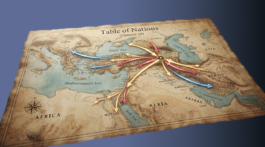
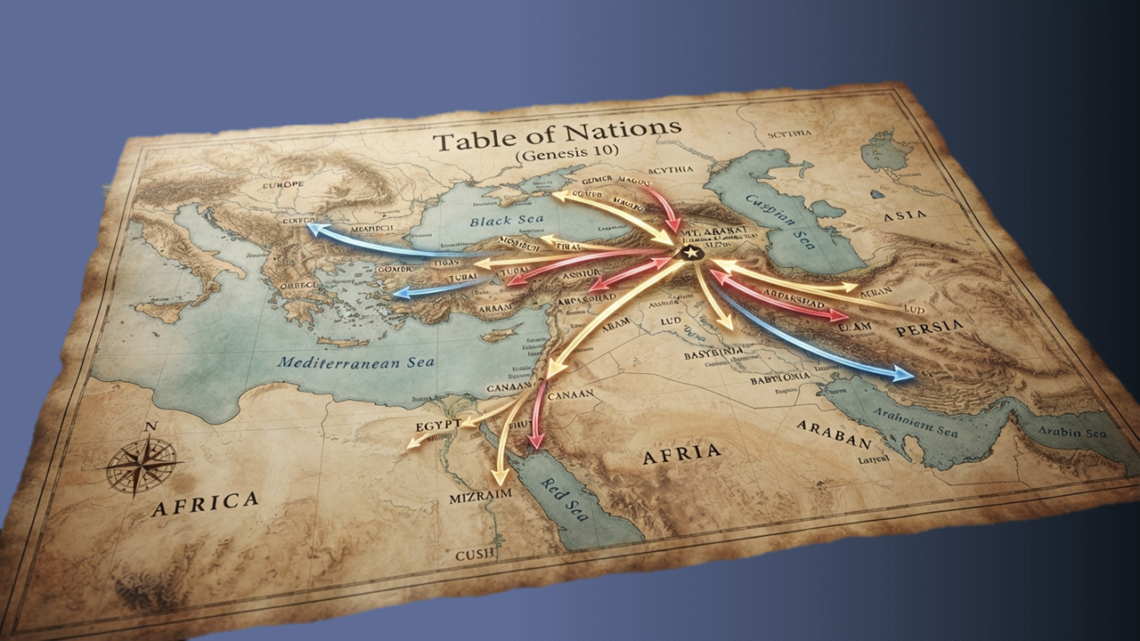
And that’s why the author shares this radically different genealogy now. Genesis 10, often called “The Table of Nations,” tells us how Noah and his sons re-filled the earth. The list contains seventy names, and forms the basis of a Hebrew tradition that the world contains seventy nations—a tradition that the Bible references later, specifically in the gospel of Luke.
Noah’s family fulfills that part of the original, now repeated, commission to mankind. Still, something has changed. Changed by the catastrophe of the Fall, and now the catastrophe of the Flood. Eden’s charge included dominion — ruling the animals, the fish, the birds. Noah’s version keeps the multiply-and-fill half intact, and man retains dominion. But now, every living creature will fear and dread humanity rather than simply answer to it. Still dominion, but one of fear instead of harmony. Mankind ceased to trust in God, and now the animal world can no longer trust mankind.
There remains yet one more act of repetition to complete the re-establishment of life as it existed before the Flood. God established capital punishment to place a limit on violence. But as Noah’s drunkenness demonstrated, human frailty has not been eliminated. And as we shall see next, neither has human rebellion.