















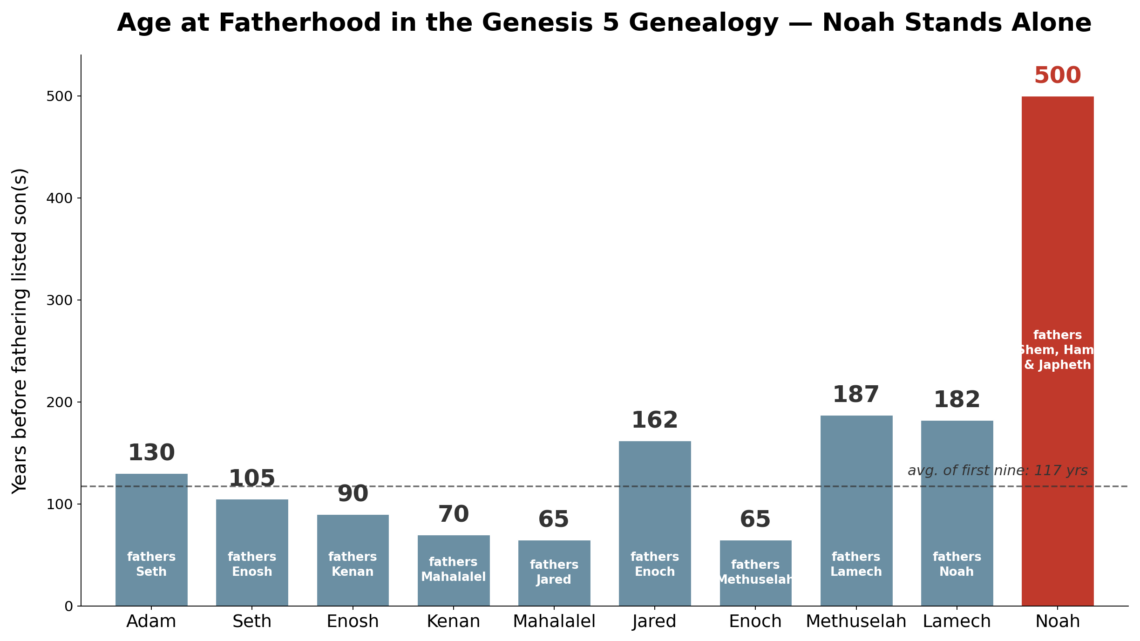
The Genesis 5 genealogy forms a chain with ten links, and we’ve already seen two of those links standing out as different. Now we turn to the third break in the pattern, link number ten: Noah.
He breaks the pattern in several ways. Noah breaks the pattern much like Enoch: it doesn’t list a death for either of them. And then there’s Noah’s age before becoming a father.
Another break with the pattern, but not as obvious. The nine generations before Noah — Adam through Lamech — average about 117 years at first fatherhood. The longest time being Methuselah’s 187 years. But for Noah, it’s 500 years! That’s not just a little longer, it’s more than 4 times longer than the average, and nearly three times as long as Methuselah!
Enoch’s story shows us that this genealogy uses numbers symbolically to tell us a story. Seventh generation and 365 years—with no death—communicates a clear message. Surely this radical difference in the age before becoming a father must mean something. That’s one unresolved question. But that’s not the only one.
After stating 500 years, the author adds yet another break with the pattern. Up till now, every generation says that the individual lived so many years, and fathered—the next person in line. But the Noah link doesn’t do that. It says he became the father of not one, but three sons: Shem, Ham and Japheth.
This naturally raises a question: were they triplets? Reading further along in Genesis, we discover that they are not. So why name them all at once, instead of just the firstborn? But that further reading also reveals that Shem, although named first, is not the firstborn.
We now have three separate breaks in the pattern. 1) The 500 years before a son is identified, 2) naming 3 offspring at once, rather than just one, and 3) why name Shem first, when he’s not the firstborn?
Three questions, and they turn out to share one answer.
Go back to that 500 years. Genesis gives us a precedent for what “father of” can mean, and it isn’t always the nearest generation. In Genesis 46, Leah’s genealogy includes her grandchildren, and even two great-grandchildren, as her “sons and daughters.”
And people in the gospels often referred to Jesus as “Son of David,” even though David reigned roughly 1000 years before Christ’s birth. So “father,” “mother,” might indicate a progenitor, but not necessarily an immediate ancestor.
Once you allow that, 500 years stops looking like an error and starts looking like a signal. Shem, Ham, and Japheth are far more likely to be Noah’s grandsons, or even great-grandsons, than his literal sons born in old age.
That also answers the second question. If Noah’s entry skips generations, it isn’t trying to list every link in Noah’s chain. It’s naming three people for a reason that has nothing to do with birth order — and the reason arrives two chapters later. These are the three who walk onto the ark. They and their wives are the whole of what comes out the other side of the flood. The genealogy was never counting descendants. It was counting survivors.
Which leaves the third question, and it’s the one that points furthest ahead. Shem goes first not because he was born first, but because his line is the one the story is about to follow. Turn the page into the next genealogy, and it opens with him — running from Shem straight through to Abram. The author has already told us who matters before we get there.
So: no death for Noah, an age four times the average, three names instead of one, and the “wrong” son listed first. Four breaks in a single entry, and every one of them points the same direction — toward the flood, and beyond.