















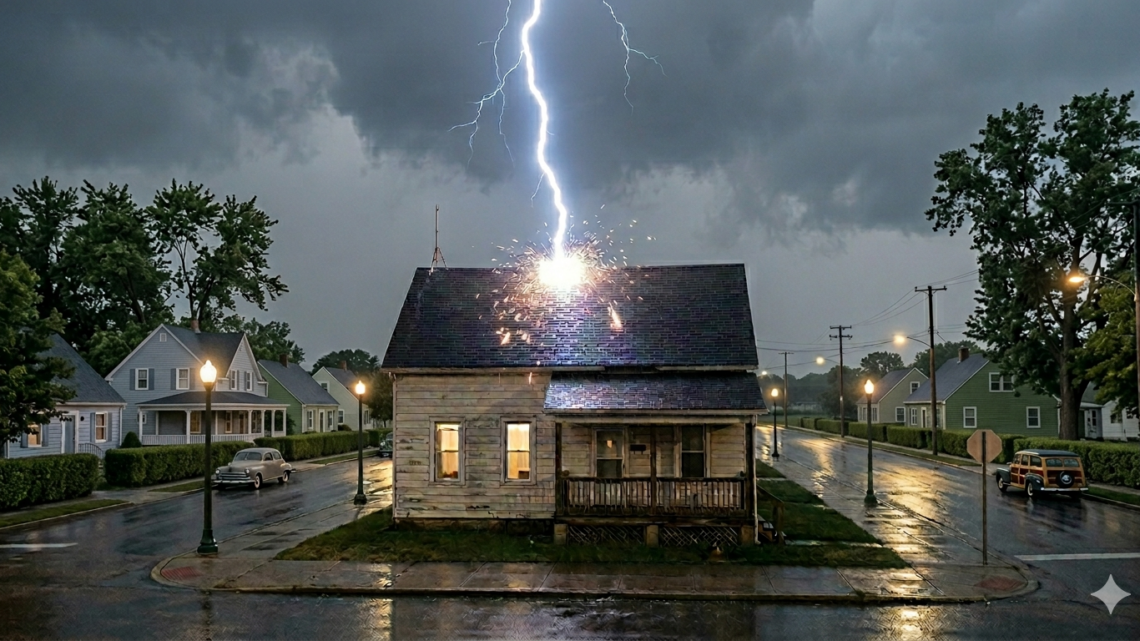
Shortly after my 12th birthday, lightning struck the house we lived in. It cracked the bathtub my father had bathed in barely an hour earlier. My mother stepped out of the kitchen seconds before the glass lighting fixture exploded into a thousand deadly shards. Then the attic caught fire.
Like the thief on the cross, we can commit to Christ at the last moment. But that moment may come without notice.
So how do we prepare, for both the decisive moment—if we are aware of it—or for the unanticipated sudden end?
Not by going back through our history, compiling a list of every sin committed. Not by trying to remember every idle word, every moment of selfishness, every quiet failure. And what of the sins we did not recognize? No, we will never finish. The futile search will occupy every available moment, and eventually lead to despair and paralysis.
Satan wants wants each of us to focus on self. He wants us cataloguing our flaws, and convinced we are unsalvageable. That will not prepare us for the crisis. It is dwelling in crisis. Dwelling in despair.
We will need courage and hope to make the ultimate commitment. And we will find reasons for that in our past as well. Instead of focusing on our failures, we need to look back at our history and recognize how God has moved through it. Find the moments where we could not see a way forward, and then one appeared. Find the times he came through when we had stopped expecting it. Build that history of recognition — because when the moment of real testing comes, that is what we will draw on.
John Walton, writing on the Old Testament, says something I keep returning to: God may strike without cause, but he never strikes without purpose. That is not a comfortable statement. Nothing about Job’s story is comfortable. But it is trustworthy. Joseph said to his brothers at the end of everything: you meant it for evil. God meant it for good. The same God is at work in our lives — even in the parts that make no sense yet.
We have this idea that we get what we deserve. Then we run into Job, and Joseph, and — if we are paying attention — Jesus. None of them got what they deserved. The pattern of Scripture is not fairness. It is faithfulness.
I will tell you something I have been reluctant to share. Not long ago I was struggling and said to God — not politely — why all these obstacles? You have given me gifts. Why won’t you clear the road? The impression that came back was very strong and very quiet: I couldn’t get you where you are by any other road than the one I’ve led you.
His grace is sufficient. I know that sounds like a plaque on a wall. It is not. It is a fact that has survived actual testing.
The older I get, the more I find I am less certain about the future and more certain about God. I used to think preparation meant having the right chart, the right sequence of events, the right theological positions locked in. Now I think preparation means this: trust him a little today. And a little more tomorrow.
You do not have to trust him with everything at once. You do not have to be Latimer at the stake on a Tuesday morning in March. You have to trust him with what is in front of you today. And then again tomorrow.
That is how faith grows. Not in a single dramatic moment, but in the accumulation of small acts of trust that build, over time, into something that can hold weight when weight arrives.
Perfectionism says: fix yourself. Account for every failure. Achieve the standard. Perfect commitment says: fix your eyes on God. What has he done? Who is he? Can he be trusted? Those are the questions worth living inside.
When my last moments come, I hope my mind is on him and not on my record. I hope I can say, with Job: though he slay me, yet will I trust in him. That is the only perfection I seek. Every day.
Thou wilt keep him in perfect peace, whose mind is stayed on thee. — Isaiah 26:3
You want perfect peace? That is how. Not by achieving more, confessing more, performing better. By staying your mind on Christ.
Trust him a little today. And a little more tomorrow. That is enough. That has always been enough.
If you’d like Ed to speak at your church, contact him at
BibleJourneys@Yahoomail.com
Put “Speaking Inquiry” in the subject line.