











We began with a crashed system and a reboot. We end somewhere else entirely.
Look back at where we started. A world created for joy and collaboration, corrupted by a virus introduced in a garden, cascading through four generations until Lamech sang his war song to his wives. A God who grieved — not that He had made humanity, but that humanity had made itself into this. The event log recording each catastrophic step.
And then the flood. De-creation running Genesis 1 backward. The firmament failing. Dry land disappearing. Eight souls afloat in a watery world without form and void. The same darkness. The same deep. The same silence.
Then: God remembered Noah.
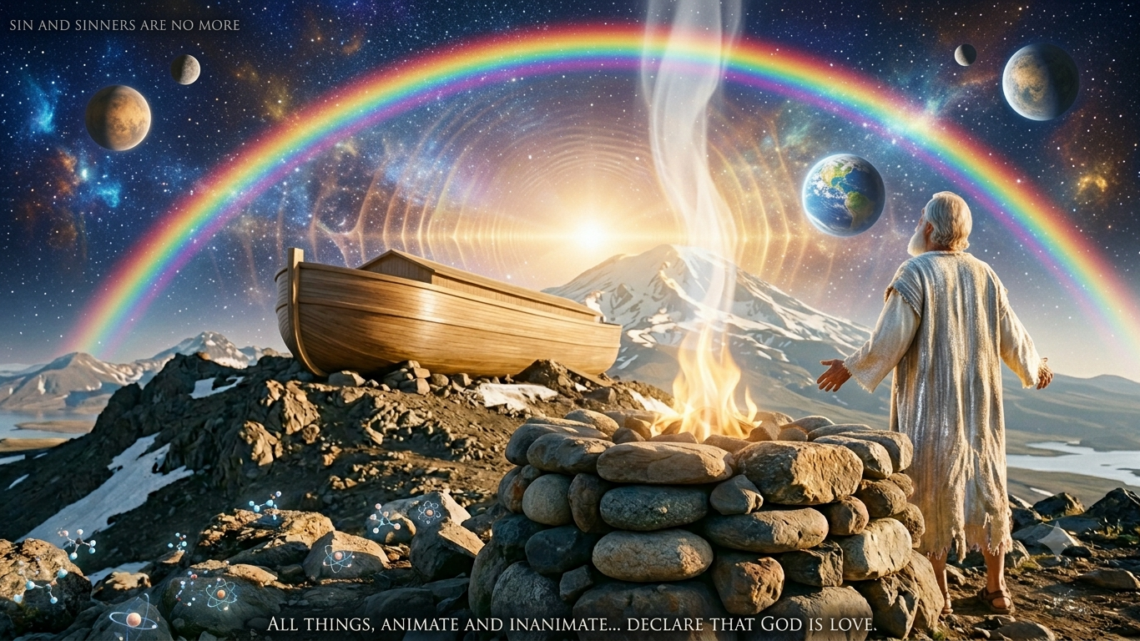
The wind passed over the waters. The dove flew out and found no rest, flew out and returned with an olive leaf, flew out and did not return. The ark rested on Ararat. Noah, whose name meant rest, offered his sacrifice. And God smelled the aroma of rest — nîḥôaḥ — and found His own rest from the terrible work of the Flood.
The reboot was complete. Or nearly.
Here is what God said to Himself in that moment. “I will never again curse the ground on account of man, for the intent of man’s heart is evil from his youth.” Read that carefully. God is not rewarding improved humanity. He knows the virus persists. He is simply choosing a different response to the same human failure. The flood was the last of its kind — not because humanity graduated beyond needing it, but because God committed to a different way forward.
Something shifted. Not in us. In Him.
And that shift echoes forward through the entire Scripture. Once you hear it, you cannot stop hearing it.
Moses stretched his hand over the Red Sea, and the waters divided. Israel walked through on dry ground. The army of Pharaoh — the men who had drowned Hebrew sons in the Nile — drowned in turn. Judgment and deliverance. Same water. Same act.
Forty years later, the Jordan parted. Another generation walked through on dry ground into the land God had promised. The pattern repeating. The waters gathering, the dry land appearing — day three of creation, enacted again.
Centuries later, the prophets described the coming restoration in the same language. A highway through the wilderness. Water in the desert. A new exodus. A new creation.
And in Revelation, the Euphrates dried up. The last great water barrier removed. The people of God crossing over, once more, on dry ground. The final echo of the first creation — waters gathered, dry land appearing, life renewed.
When God delivers His people, He signs His work the same way. The waters part. The dry land appears. The creation day repeats.
The Flood wasn’t an interruption of that pattern. It was the pattern’s first full statement. The template from which every subsequent act of divine deliverance was drawn.
You have been sitting in the concert hall your whole life. The symphony has been playing since Genesis 1. Every exodus, every crossing, every parting of waters — the same theme, the same composer, the same signature in the music.
Now you know what to listen for.
Because the symphony isn’t finished. The virus persists, as God Himself acknowledged at the close of the Flood. The reboot was real but not final. The rest that Noah’s name promised, that the ark found on Ararat, that God smelled in the smoke of the sacrifice — it was genuine. But it was foretaste, not fulfillment.
The score has one more movement. The waters will part again. The dry land will appear again. And this time, the rest will be permanent.
“And there will be no more sea.”
The first creation began with water covering everything. The new creation ends with the water gone. The chaos finally, fully, permanently gathered and held.
The reboot will be complete.