


















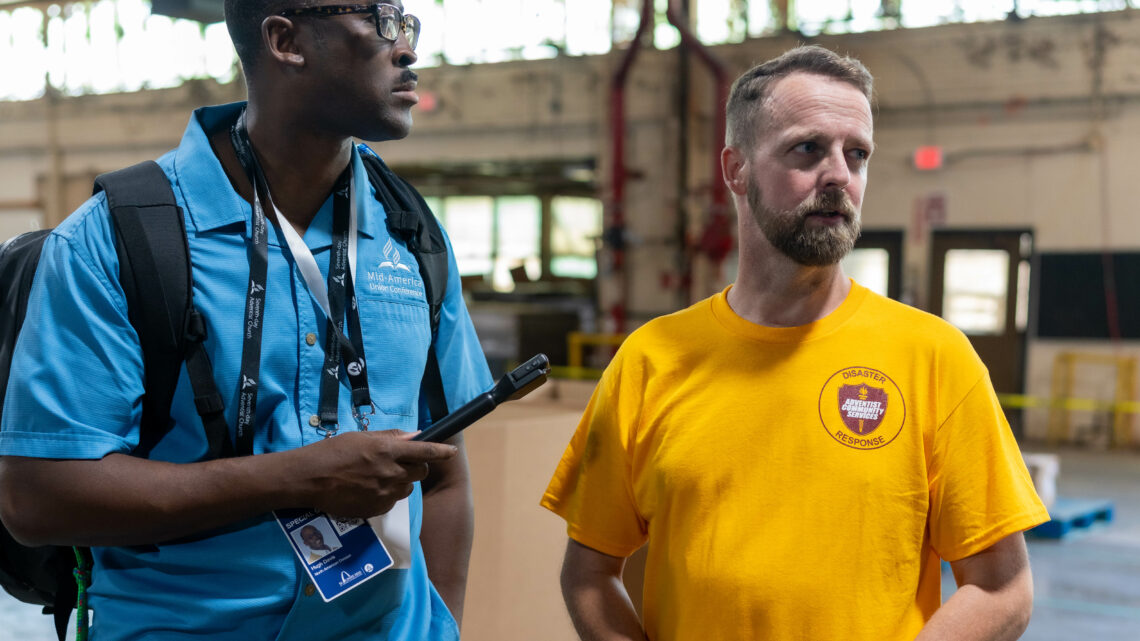
Iowa-Missouri Conference pastor Brian Schwering recently completed coordinating a massive disaster relief warehouse operation in St. Louis, Missouri, following devastating tornado damage in May 2025.
Schwering, who serves as both a conference pastor and ACS director, led the North American Division Adventist Community Services response as primary coordinator for the first month of operations. The 144,000-square-foot warehouse provided a steady supply of goods to tornado survivors as they progressed through the emergency response, relief, and long-term recovery phases.
Students bring joy to exhausting work
Twelve Sunnydale Adventist Academy students transformed the demanding operation with their infectious enthusiasm. “We had been there for a couple of weeks before the students came, and all of us were tired. We were starting to get frustrated,” Schwering recalled.
“And then the students came, and they were doing the same work we were. They were out there in the heat, sweating, but they were laughing and joking… And they were singing while we were packing up. It was just so heartwarming and inspiring.”
The students worked at distribution locations, helping pack and distribute goods to tornado survivors while maintaining team morale through their joyful approach to the demanding physical labor.
Witnessing through difficulties
The warehouse operation created unexpected ministry opportunities as Adventist and community volunteers worked side by side. “We try to engage both local community volunteers and Adventist volunteers at the same time,” Schwering explained. “So that gives a lot of opportunity for the Adventist volunteers to witness.”
Rather than formal evangelism, relationships developed naturally through shared labor and daily prayer times. “After a little while you’re working with somebody for a couple of hours or sometimes a couple of days, they start to see differences in you versus other people they know, and they’ll ask questions,” he said.
Community volunteers who observed morning and lunch prayers eventually began asking about faith and church attendance. “There is a lot of opportunities here for ministry that most people don’t realize.”
Operating disaster relief also had a profound impact on Schwering’s pastoral ministry. Working at distribution centers, he witnessed survivors who had lost everything entering “self-preservation mode” —taking as much as possible not from greed, but from genuine need to survive and care for their families. “That helped me realize how difficult life can be for people,” he reflected.
God’s perfect timing
Schwering testified to experiencing divine provision throughout the operation. When warehouse supplies ran dangerously low after large orders, concern mounted about meeting community needs. “And it was like, Lord, what are we going to do? And then, just like that, I got a phone call. Hey, I’ve got some stuff for you. And then another phone call… And God timed it out just perfect to when we needed it.”
Sophisticated relief operation
The warehouse operated through three distinct disaster phases, initially providing life-sustaining products such as food, water and hygiene items during emergency responses. As survivors transitioned to recovery, their inventory shifted to household goods, including furniture and appliances.
The operation used a sophisticated sorting system with products categorized and tracked through barcode scanning, designed for speed since warehouses typically go up within the first 72 hours of disaster. The facility received donations ranging from two 26-foot truckloads of brand-new furniture from local stores to partnerships with major corporations, including Amazon and Good360.
Path to ACS ministry
Schwering’s involvement began unexpectedly in 2018 when he and his wife attended a Des Moines training on emergency response “out of boredom.” After responding to tornado and flood damage in Jefferson City, Missouri, the following year, “we’ve kind of been involved ever since,” he said.
He emphasized that ACS work requires patience and interpersonal skills more than a specific professional background, noting the key qualification is patience since “it’s a disaster, so nothing’s going the way you want it to anyway when you start.”
Preparing churches for response
For church members interested in disaster preparedness, Schwering recommends taking available training through the conference or online through Adventist Learning Community. However, he stressed the foundational importance of establishing local ACS programs.
“Probably one of the biggest things is, if they don’t have an ACS program in [your] church, to get one started. That’s kind of the foundation of the whole system,” he explained. “A functioning ACS system or program in your church helps you to build those community connections that you need and get you engaged with the community. So when something happens, you’re more prepared because you know people and you know what to do.”
The warehouse operation required 20 to 30 people to run effectively, highlighting the importance of building relationships before disasters strike rather than scrambling to find people to help you after the disaster.
For information about ACS training or establishing church programs, contact the Iowa-Missouri Conference office or visit communityservices.org.