













The list
I was kneeling in front of a heating stove with mirrored panels, teaching my 18-month-old brother to crawl. I had worked it out myself — chest up first, then hips, then hands and knees — the way a physical therapist might, except I was four and nobody had asked me to.
Nobody assigned me to invent a milkshake holder, built a few years later out of scrap wood so Rick could hold his own drink in the car. I was tired of holding it for him on every family trip. I also wanted an ice cream cone once in awhile and was not allowed to if I was holding his drink.
Nobody assigned me the job of interpreter, translating my brother’s first words for a mother who could only catch some of them.
Nobody assigned me the bicycle I fitted with training wheels because I wanted somebody to ride with. To go anywhere with my brother, I rode three times as far as he did.
And nobody assigned me the summer I taught myself to write computer software from scratch, because a teacher had decided my brother could not learn long division. I refused to accept the way he was being taught was right for him–and he learned long division in weeks.
Our play was his therapy
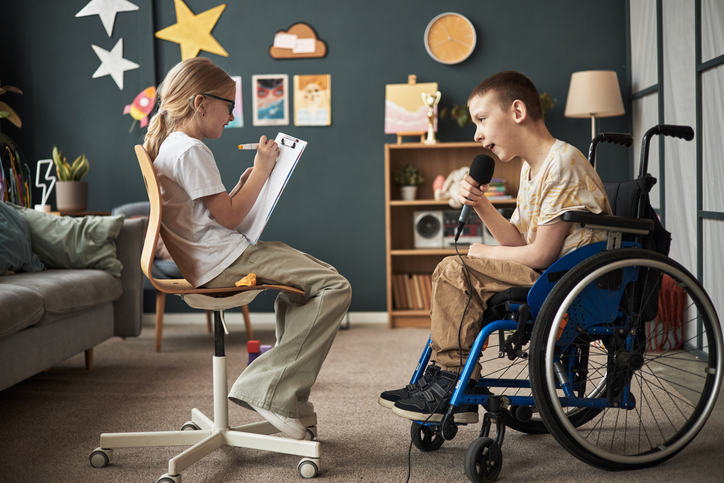
From the time I was very small, playing was work. I adapted the games. I was the one who figured out how a thing could be done. Much of our play was his therapy.
This is not what siblings do
Every older sibling adapts. You slow down for the little one. You let him win. You carry him when he is tired, and you get sick of it, and that is ordinary childhood.
The difference is that ordinary childhood is temporary. The little one catches up. The gap closes. One day you are two adults, and you don’t have to slow down anymore.
Our gap never closed. Every year, the distance between what I could do and what Rick could do got wider. I was not slowing down for a little brother who would eventually catch me. I was building, permanently, for someone who never would — and each thing I built bought a year, maybe two, before the next thing had to be invented.
There is another difference.
He was “special” and everyone saw him that way. Rick sang special music as a boy at our small church in farm-country Nebraska, and it showed up in the newspaper. Years later and a long way west, in San Bernardino, his youth group worked out a way to get him up a mountain on a hike — and it was extraordinary, and he was fortunate to have friends like that — it made the front page of a good-sized city paper.
Other people’s brothers sing at church. Other people’s brothers go hiking. Nothing happens. So you grow up beside someone whose ordinary afternoons are news, and you learn young your family is a story other people are reading.
Rick had a name. I was “Rick’s sister.”
His sister stood at a distance
Moses’ mother put him in a basket among the reeds, because he would die otherwise. And his sister was posted on the riverbank — a child herself — standing at a distance to watch. (Exodus 2:4) When Pharaoh’s daughter found the basket, the girl steps forward and improvises. Shall I go and get one of the Hebrew women to nurse the baby for you? (Exodus 2:7) She has worked out, on the spot, a way for her brother to survive — and to come back to their own mother while he does it. A whole nation depended on what she did whether they knew it or not.
She is not named. She is his sister, and she is not mentioned again for 80 years.
I was the sister at a distance from the time I was three, and most of what I invented worked.
What I could not invent was the thing I was actually hungry for. Someone to be bored with. Someone to fight with over nothing.
I wanted a brother who was a brother, rather than a project with a person inside it.
Lord, You know the ones who are always the ones carrying. Thank You for what they build. Give them, sometime, an ordinary afternoon. Amen.
Next time: why none of this looked like a problem to anyone, including me.
Click HERE to see the 1st in this series.