














In 2026 I am exploring early Sabbatarian Adventists in the states that now comprise the Mid-America Union. There is no way to know who the first Millerite or Adventist was in each state. Instead, I am usually featuring the first people to write to the Advent Review and Sabbath Herald (forerunner of the Adventist Review) from the territories or states in what is now the Mid-America Union. In the case of Susan J. Bysong Shaw, although she was not the first to write to the Review from Colorado, there is good evidence she was the first to arrive.
According to family lore passed down to Sophia Ann (née Bysong) Snair’s grandchildren, Great-Aunt Susan caused a stir in the Bysong family when she ran away at the age of sixteen and joined the Seventh-day Adventist Church. To understand why Susan might have run away, one needs to know more about her family.
Immigrant Background
Sophia Ann* and Susan were sisters in a large family of what were probably German-speaking French and Swiss immigrants. According to their brother, John, their father, Joseph (1802-1870), was a French Catholic who immigrated from Alsace-Lorraine to Montreal, Quebec, in 1824. There he met and married Swiss-born Anna Speicher (1809-1849). Their oldest child, Samuel (1830-1915), was also born in Canada.
The Bysong family’s background is a conundrum of confusing details, not the least of which are their ethnic heritage and the numerous ways the surname is spelled: Beisang or Beysang were probably the original spellings, with Bysong an American corruption (these are among numerous other spelling variations in the records including Bysung and Bison). Alsace-Lorraine is a region with deep German roots that has been passed between France and Germany numerous times over the centuries. Beisang/Beysang, while Germanic in spelling, also has possible French roots.
According to John, his parents moved to Knox County, Ohio, in 1830. In 1831, Joseph and Anna went through a second marriage ceremony in Erie County, New York, probably in Buffalo. This seems to indicate that 1831 rather than 1830 is the correct date for their migration from Canada to the United States. It was not uncommon for immigrants to go through a second marriage ceremony in a new country to ensure the legal benefits afforded married couples in their new homeland. Records indicate that Joseph purchased government land in 1840 in Knox County, Ohio, and established a farm. All of Joseph and Anna’s subsequent children were born in Ohio beginning with Sophia Ann in 1835 (although, Sophia Ann appears to have believed she was born in Canada, this does not make sense unless her mother returned to Canada to give birth). Given the gap between Samuel’s and Sophia Ann’s births, there may have been another child who died. John’s obituary says there were eight children; I have record of seven. Susan was the youngest, born in Knox County on September 10, 1846.
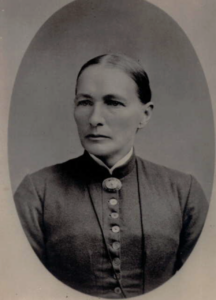
Sophia Ann Bysong Snair, photo courtesy of Patrick Hammond.
Motherless Child
Susan was about four years old when her mother died. Although her father remarried in 1851— at this time, he married Ann Marie Hauck; evidence suggests he subsequently married two more times, all women with German heritage—Sophia Ann became the mother figure to her youngest siblings.
In 1856 Joseph Bysong decided to move his entire family to Fayette County, Iowa. Initially, the family lived in Windsor Township, though later correspondence was sent from West Union, Iowa. What happened next requires some speculation.
In 1860, Susan had a new step-mother, Lydia, who was close to her sister, Sophia Ann’s age (there were also two baby half-siblings). Joseph was approaching sixty years of age. Meanwhile Sophia Ann married Richard Snair in the early 1860s and moved to Gilpin County, Colorado. It is easy to imagine teenage Susan feeling abandoned with an aging father, older siblings leaving home, and a new, young step-mother absorbed with the care of her own babies. When Seventh-day Adventists from Waukon, Iowa, arrived in Fayette County, Iowa, keen to make converts, Susan readily soaked up the attention they gave her.
In about 1860, recent converts Dan T. Shireman and his wife, Amelia, attempted to spread the Adventist message in Amelia’s hometown of West Union, Iowa. They met with limited success, and Shireman, along with George I. Butler (then a local church elder, but soon to become Iowa Conference president), and John Cole (a recent convert in Waukon) all called for a minister to come to Fayette County in October 1862 (Advent Review and Sabbath Herald).
Merritt E. Cornell answered the call, conducting meetings there in November and December 1862 (Advent Review and Sabbath Herald). Shireman and a “Brother Gillet” continued working in the area, while other Adventists from Waukon travelled the forty miles to Fayette to support him in his preaching (Advent Review and Sabbath Herald). It is easy to imagine that Susan’s family was not enamored by her interest in Cornell’s preaching. It is evident that she made new friends among the Waukon members, so leaving to go live with them while her family adjusted would have been appealing. We do not know which of these people drew Susan into their sphere of influence, but we do know that she listened to Cornell’s preaching and started keeping the Sabbath in early 1863.
Susan wrote to the Review from West Union in March 1863:
For eight weeks I have been striving to keep the Sabbath of the Lord, and am not weary in well-doing, but delight in the law of God. My heart glows with gratitude to him who first arrested my attention, opened my blinded eyes, and turned my feet into the way of truth. I praise God that I ever heard the last call of mercy. I was awakened to the truth during the labors of Bro. Cornell in this place; and I feel to give glory and honor unto God, who has delivered me from error, and made me rejoice in the truth. He is still leading me. I can truly say that I love both parts of the message, the commandments of God and the faith of Jesus. It severs the cord of friendship from this popular world, but what are the fashions, the pride of this life, when compared with the glory which awaits the faithful and obedient! O[h] I want to share in that incorruptible inheritance, though it be by the loss of all earthly friends.
The severed “cord of friendship” and “loss of all earthly friends” may have been allusions to the conflict that drove her from home. Susan continued with an affirmation of her faith.
We have one Friend in whom there is no variableness nor a shadow of turning. There is also a precious promise given us that the angel of the Lord encampeth round about them that fear him. O[h] I rejoice in these glorious truths. Like the pure gold, they shine brighter and brighter. Our Saviour is soon coming. How cheering the thought! But I sometimes fear that I shall not be ready. I find a warfare daily, having many foes within. The way seems more narrow every day, but my hope and trust are in Jesus, who is worthy. I feel like striving more earnestly to gain a home in the earth made new, and with all the redeemed partake of the fruit of the tree of life. (Advent Review and Sabbath Herald)
Bysong family lore claims that Susan’s conversion to the Seventh-day Adventist Church caused a rift between Sophia Ann and Susan. Thus, shortly after their marriage, when Sophia Ann and Richard moved to Gilpin County, Colorado, Susan was left behind. But not for long. Sophia Ann made the arduous wagon trip back to Iowa to retrieve Susan. The family story claims the sisters, traveling by wagon to Colorado, were attacked by Indians, but no one was harmed. Thus, sometime between 1863 and 1866, Susan became the first Seventh-day Adventist in the Territory of Colorado.
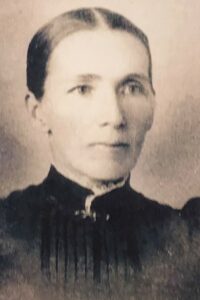
Susan J. Bysong Shaw, photo courtesty of Patrick Hammond.
Life of Faithfulness
The record of Susan’s life subsequent to her move to Colorado contains gaps. However, enough information is available to assemble a good outline.
By one account, Susan first worked for a miner in Denver. There is no evidence either supporting or refuting this. By 1867, she was married to Horace Guy Shaw (1837-1876), a carpenter and miner in Central City, Colorado, who was not an Adventist at th. Between 1867 and 1870, Susan gave birth to two children, Emma I. (1867-1964) and John Luis (1870-1952). She continued to subscribe to the Advent Review and Sabbath Herald. Sophia Ann and her family lived nearby. The Shaws evidently moved to Golden between 1870 and 1873.
Susan’s life took a new turn in 1873, one instigated by the arrival of James and Ellen White in Colorado in 1872 at the invitation of the Ellen’s niece, Mary, and her husband William A. Walling. While the Wallings resided in Denver, William owned a mill in Black Hawk, near Central City, that supplied lumber to the mines for building shaft supports. The Whites were seeking relaxation and recuperation between the events of their busy lives, and Walling offered them the use of a cabin near his mill. The Whites so enjoyed their mountain vacation, they made it a regular summer sojourn for the next several years, eventually buying their own property near Rollinsville.
The following summer (1873), the Whites invited D. M. Canright and his wife to join them in their mountain vacation. It turned into an unhappy experience when James White and Canright started an argument. Canright and his wife left prematurely, retreating down the mountains to Golden. Here they enjoyed the hospitality of Horace and Susan Shaw. Canright conducted the first Adventist evangelistic meetings in Golden beginning August 30, 1873. It was at this time that Horace became interested in his wife’s religious beliefs. Sophia Ann was not far behind, as evidenced by her subscription to the Advent Review and Sabbath Herald in 1874. Susan was no longer the only Seventh-day Adventist in her family.
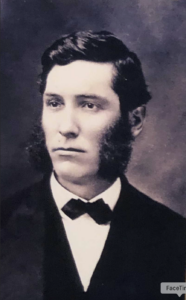
Horace Guy Shaw, photo courtesy of Patrick Hammond.
Horace was not a well man, though. When he became ill, as well as the exact nature of his illness, is uncertain. His obituary described it as “paralysis induced by epilepsy” (Advent Review and Sabbath Herald). By 1875, the Shaws moved east to Waukon, where their third child, Horace Guy (1875-1960), named after his father, was born. Then Horace Sr. went to Battle Creek, Michigan, for treatment at the Battle Creek Sanitarium, where he died on May 11, 1876. He was buried in Oak Hill Cemetery in Battle Creek, Michigan.
As a young widow with small children, Susan remained in Waukon for next eleven years, where she probably found solace in friends who had helped her in 1863. She took in boarders to support herself and her children. Among her boarders was her niece, Inez Sarah (1853-1889), Sophia Ann’s daughter. Under Aunt Susan’s influence, Inez made the decision to join the Adventist Church in 1882 (Advent Review and Sabbath Herald).
In the autumn of 1887, Susan’s daughter Emma moved to Colorado Springs (or Colorado City, now the Old Colorado City neighborhood of Colorado Springs) after she completed teacher’s training in Iowa. Emma taught in Lake George before her marriage. Susan most likely returned to Colorado at this time, and the move put the Shaws in proximity to the Snairs (now living in Park County) once again. Emma married William Eames in Colorado Springs on May 29, 1890, with Adventist minister Sharp Smith officiating. William, the son of an old New England family, was the only member of his family to move to Colorado, and he appears to have joined the Adventist church in Colorado Springs. Susan, Emma, William, and perhaps Sophia Ann (who also moved to [Old] Colorado City, although probably not until after her husband’s death in 1891) were quite likely among the founding members of the first Colorado Springs congregation which was organized into a church and admitted to the Colorado Conference (now Rocky Mountain Conference) on September 4, 1890.
During Susan’s absence, Adventist church membership in Colorado had grown until it could support a local conference. The Colorado Conference, which included Wyoming and New Mexico, was organized in the autumn of 1883. The Colorado Sabbath School Association was organized at the same time. The conference issued Susan a missionary license in 1891, which she held until 1894, if not until her death. She was elected president of the Colorado Sabbath School Association in 1891, a position she held for two years, and then remained on the executive committee until at least 1894.
Susan died on April 29, 1895, in [Old] Colorado City. She was just 48 years old. (Her obituary incorrectly states that she was 46. See Review). Sophia Ann died of pneumonia in [Old] Colorado City two years later. She was 62 (Review). Both sisters are buried in the Evergreen Cemetery in Colorado Springs.
Susan’s obituary described her as “an exemplary member, and she ‘being dead yet speaketh.'” It was a truth lived out in the lives of two of her children. Emma and William remained in Colorado Springs, where William took charge of the construction of the congregation’s second church building around 1920. In 1952 Emma was honored for 79 years of Sabbath School membership in the Colorado Conference. John graduated from Battle Creek College in 1893. Among other positions, he became a missionary to South Africa and India. Upon his return from the mission field, he served in the General Conference of Seventh-day Adventists’ treasury department.
*Sophia Ann was known as Ann, although some records list her as Hannah or Anna. However, as her mother and two step-mothers were all named some variation of Anna, Ann, Annette, or Annetta, this article uses her full name, Sophia Ann, for clarification.
