















Last time we saw a world created for joy and collaboration instead “filled with violence.” Filled, saturated, flooded. Exhausted by the violence espoused in Lamech’s savage song.
Time for a re-boot.
Not a cold re-boot. God had given life to humankind, and He was determined to preserve it—at all costs. Meanwhile the line of Seth had been calling on the name of the Lord — answering Lamech’s self-exaltation with something older and truer.
We sometimes overlook the intimate connection humanity has with this world. In Genesis, when the dry land appears holding the waters at bay, it is man’s dwelling place, the source of his very substance which receives the breath of life.
When Adam rebelled against God, the ground rebelled against Adam with thorns and thistles. The trickle of disorder loosed in the garden swelled into a torrent through the likes of Lamech — saturating mankind, then drowning the earth itself.
Distressed as He was by the evil humanity had visited upon themselves, God knew that such a culture must be purged. Still, He was loathe to destroy the race He had kissed into existence. God desired to preserve humankind, but He could not so long as the virus remained unchecked. Only those with demonstrated immunity to the virus could survive the purge and carry life forward — and the line of Seth, calling on the name of the Lord, had demonstrated exactly that. So God called someone of that line. Noah, just the man to re-boot the wearied world. Noah, whose very name meant rest.
God told Noah to prepare a vessel to preserve life, and warn a world of the impending Flood. God gave Noah very specific directions on the construction of the massive vessel. Once completed, the loading of its precious cargo began. In creation week, God made the animals before humankind. Here the process reverses.
Humankind—represented by Noah and his family —enters the Ark first. Then God guided every kind of living creatures into the completed ark, to repopulate the promised renewed creation.
A tense week of waiting followed. And then the rains came down, the cooling rains came down.
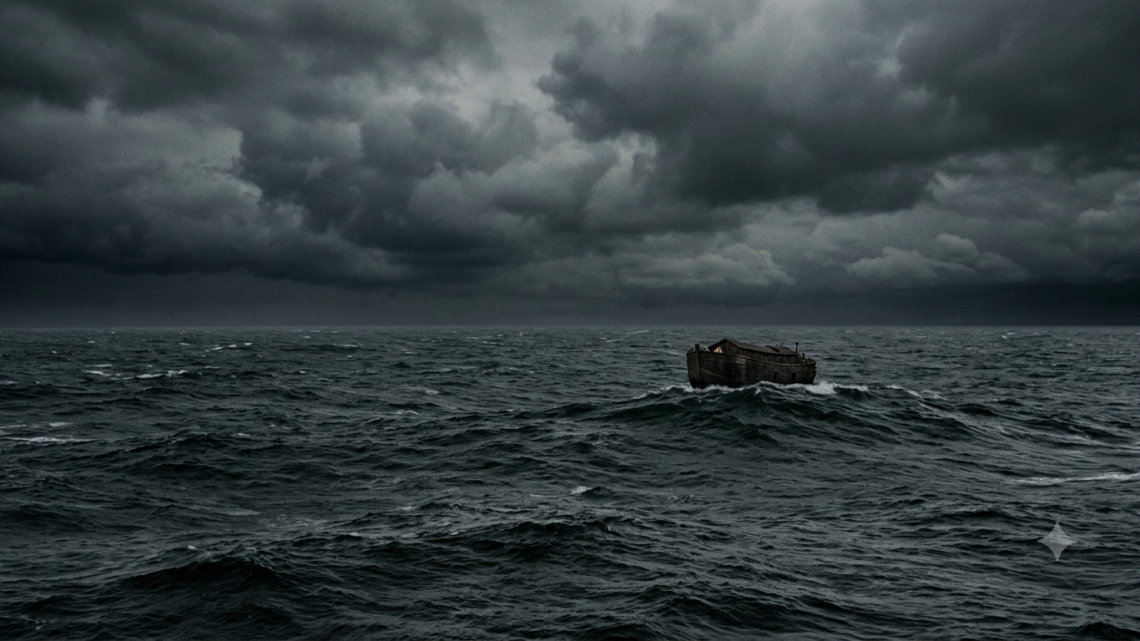
Yet more remained. The de-creation continued. On the third day of creation, the dry land appeared, between the waters divided on the second day. In the Flood story, not only did the windows of heaven open in rain, but also the fountains of the great deep burst open.
The waters divided on creation’s second day reunited, and the dry land disappeared. So we find ourselves, with Noah and his family afloat in a watery world without form and void.
Back to the beginning, but with light and life preserved. How will re-creation begin again?
If you’d like Ed to speak at your church, contact him at
BibleJourneys@Yahoo.com
Put “Speaking Inquiry” in the subject line.