










Growing up, I learned the standard definition—that sin is the transgression of the law. Not exactly wrong, but it throws us right back into the performance model — the checklist, the audit, the flies-in-the ointment. It seems clear, until you ask the question, “Which law?”
Someone asked Jesus, “Which is the greatest commandment in the Law?” He replied, “‘Love the Lord your God with all your heart and with all your soul and with all your mind.’ This is the first and greatest commandment.” Wait! What? That’s not one of the Ten. Yet Jesus identifies it as the greatest.
According to Jesus, the greatest commandment tells us to love! But, as we have seen, love cannot be forced; it must be chosen.
So if love is the greatest commandment, what constitutes sin? Hate? Indifference? Not loving with all of ourselves? But how is that even possible. I love my wife, but sometimes I’m still selfish, thoughtless, even casually cruel. Terrible, but true. And the prophet Jeremiah warns me that my heart deceives me. I’m probably worse than I know.
In the last post I said that God made us for love, not obedience — and that love requires freedom. If that is true, it changes what sin actually is. And the answer is stranger, and more demanding, than the one most of us were taught.
There is a question that comes up constantly in online theological discussions, and it surprises me every time: what is sin? How do you know?
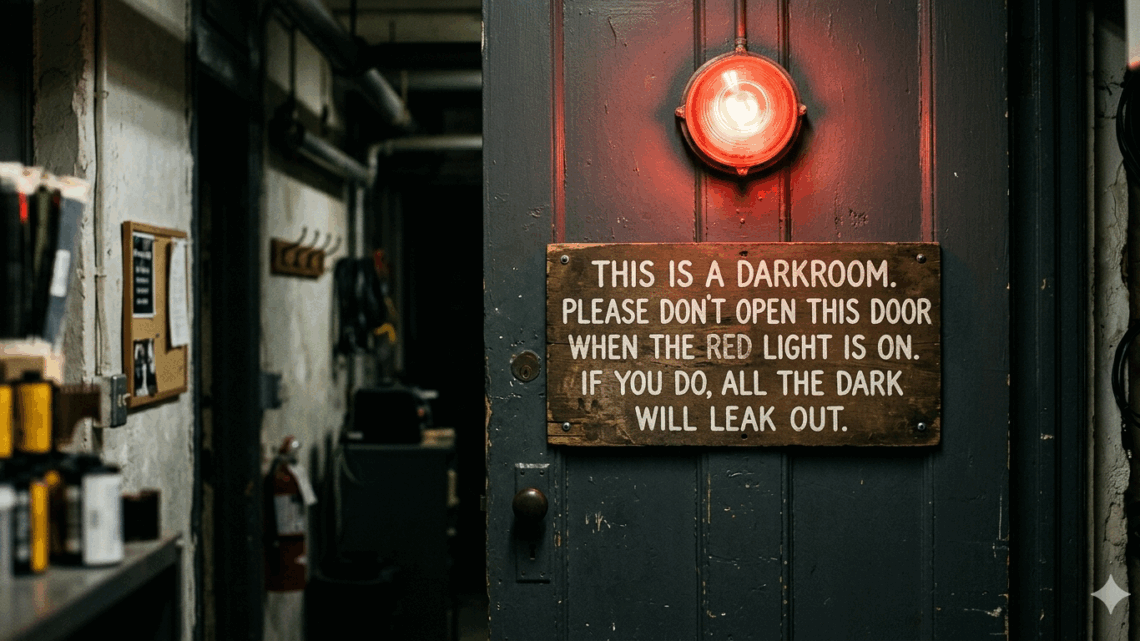
I found the answer years ago when I visited a newspaper. I passed by the photo lab, where a red light showed when the lights inside were off. Just below it, a sign read: “This is a darkroom. Please don’t open this door when the red light is on. If you do, all the dark will leak out.” We laugh because we know the problem isn’t keeping darkness in — it’s keeping light out.
Darkness is not a thing. It is the absence of a thing. A single candle eliminates it. Strike a match at night, and it can be seen for miles. Cold works the same way. We don’t add cold to a room — we remove heat. Evil, sin, distrust — same category. They have no independent existence. They are what remains when something else departs.
For the first time I realized the nature of sin. It is not the presence of something, but rather its absence. And Romans 14:23 supplied the missing part: whatever is not of faith is sin. Sin is the shadow that falls when trust leaves the room. And I find that definition both more demanding and more freeing than the one I grew up with.
More demanding — because it means that religious activity done without genuine trust in God is sin. I could pay my tithe, keep the Sabbath, give my body to be burned — and if it is all performed without faith, it profits nothing. There is no checklist long enough to substitute for trust.
More freeing — because it shifts the question from “have I done everything right?” to “am I trusting God?” One of those questions has an answer I can live with.
We say we live by faith, not by sight. But then we build elaborate end-time charts, some of them so detailed you could click a stopwatch at the first event and track everything that follows. I understand the impulse. Certainty feels safer. But certainty is the antithesis of faith.
The Jews of Jesus’ time had memorized much of Scripture. When the Messiah came, they did not recognize him. His disciples walked with the risen Christ on the road to Emmaus and still did not know who he was. Our founders predicted his return on a specific date. Kierkegaard was right: life is understood backwards, but it must be lived forwards. Prophecy is given not so we can predict, but so that when things unfold, we may have faith.
Faith, as Oswald Chambers defines it, is absolute trust in God — trust that could never imagine he would forsake us. Faith, as Ellen White puts it, is trusting God, believing that he loves us and knows best what is for our good.
Without faith, Hebrews says, it is impossible to please him. Not difficult. Impossible.
Think about what that means. What pleases God is the presence of trust. When trust is present, the light is on. When I stop trusting him — for whatever reason — the light goes out. Sin is not primarily something I do. It is what enters when trust departs. The serpent’s oldest move was not to get Eve to break a rule. It was to make her doubt: did God really say that? Is he holding out on you? Break the trust, and everything else follows.
I displease God not mainly because of the things I do badly. I displease God when I stop trusting him. That’s what happened in Eden, and it continues to this day: in billions of choices, of missed opportunities. The shadow of that Tree darkens today’s world.
But that means perfection — whatever it looks like — has something to do with faith. Not perfect performance. Perfect trust.
So what does that actually look like? I want to show you. Not as a concept. As a moment in history, at a burning stake in Oxford, in 1555.
If you’d like Ed to speak at your church, contact him at
BibleJourneys@Yahoomail.com
Put “Speaking Inquiry” in the subject line.

No Comment