















Sabbath School Lesson for April 11-17, 2026
Introduction of Lesson 3, Pride Versus Humility
Memory Text: ” ‘For whoever exalts himself will be humbled, and he who humbles himself will be exalted’ “ Luke 14:11 NKJV
We all know Satan is capable of great deception, but we shouldn’t forget that we are also capable of deceiving ourselves by denying the fact that we battle with being too proud. After all, pride was Satan’s first mistake in heaven as Lucifer, when he thought more highly of himself than he should.
Pride rears its ugly head often in response to our forgetting where our true value lies. It’s not in ourselves, in anything we might achieve or feel entitled to. We need to remind ourselves constantly that our value comes from being created by God and being the ones He came and died for. By contemplating these blessings daily, we are able to keep our pride in check and instead develop humility more in line with Christ’s example.
Having pride certainly impacts our relationship with God. Therefore, it’s a vital topic to pursue as we strive to have a closer walk with Him. Purging pride out of our thinking is difficult, to say the least, but the reward for doing it will be to make life much easier for ourselves and those around us.
To find out more about Satan’s deceptions, see https://www.outlookmag.org/the-three-tools-of-the-devil/
This week, we will explore…
- Sunday: The Tight Fingers of Pride
- Monday: Know Yourself
- Tuesday: Moses, Humble Servant
- Wednesday: The Greatest Offense
- Thursday: Look at Him
Sunday: The Tight Fingers of Pride
Lucifer felt the tight fingers of pride consume his thinking by initially allowing himself to doubt God’s love and then to lose trust in Him. Just as Adam and Eve were tempted to doubt God’s love and allowed that initial distrust to grow in their minds until it led to their sinful act of tasting the forbidden fruit.
To replace the love they once had for God, they transferred it to loving themselves and the things in their world, including the fruit they were told not to eat. 1 John 2:15-17 is basically a description of the forbidden fruit that God has cautioned us to avoid in today’s world. It consists of the lust of the flesh (the things we do), the lust of the eyes (the things we see), and the pride of life (what those lusts eventually lead to).
There are some features of pride that are permitted, however. For instance, we cam show someone appreciation and encouragement when we say that we are proud of them. It is also a good thing to strive for excellence ourselves, even though it may look to some as being proud. We must, therefore, make sure that it’s done in a way that glorifies God and not ourselves. Our value should always come from God. He gives us the desire for a purposeful direction in life and the strength and courage to reach our goals.
Verses for reflection and discussion:
1 John 2:15-17
- What kind of prideful things hinder our walk with God?
- What is the key to avoiding these lusts?
Monday: Know Yourself
Jesus tried to impress upon the disciples the importance of knowing themselves, especially those harmful thoughts of pride that we often fail to recognize. Many parables and events were designed to help them, and us, see all the ways pride creeps in, causing us to sin against God.
One stark reminder of how pride hinders our prayers from being heard was the parable about the prayers of the Pharisee and the sinful tax collector in Luke 18. We must resolve to see our true state of mind and ask God to correct any prideful thoughts and actions we may have.
The key, of course, is to have our eyes on Jesus, not ourselves. It is only then that we see our own sins and shortcomings by contrast and feel a need to confess them. When we humbly receive His grace covering our sins, we can enjoy an even closer relationship with Him.
Verses for reflection and discussion:
Luke 18:9-14
- Why did God hear the prayers of one but not the other in this story?
- What other parables and actions can you recall that demonstrate Jesus’ emphasis on the harmful effects of having pride?
- How have you personally battled with pride, and what ways have you found helpful in overcoming it?
Tuesday: Moses, Humble Servant
We feel particularly drawn to Moses as we contemplate how to have humility. Numbers 12:3 tells us: “Now the man Moses was very humble, more than all men who were on the face of the earth.” He stood out, as least in the time in which he lived, as being particularly humble and meek.
Considering the high position Moses was granted in Pharoah’s court as a young man, and the humble occupation of a shepherd that he later experienced, we must agree that it required humility to be in his shoes. He would need humility, in order to stand up to Pharoah the way he did, showing the stark contrast between Pharoah’s pride and Moses’ humility.
God spoke to Moses out of a burning bush, asking him to lead a people out of slavery. He was later the instrument God used to announce miraculous plagues that grabbed the attention of the whole land of Egypt. Despite these things that would make most men full of pride, Moses retained his lowly position before God, and was able to do the seemingly impossible task of allowing God’s people to leave their harsh bondage and return to the land God had promised them. No wonder Moses is thought to be a type of Christ, foreshadowing the person and mission of our Savior.
Verses for reflection and discussion:
Acts 7:22 and Exodus 2:12
- What reasons might Moses have had for being proud?
- How did one impulsive act cause Moses to feel humble?
Hebrews 11:24-26
- Why did Moses choose to be humble, rather than full of pride?
Numbers 12:3 and Matthew 5:5
- Why do you think Moses deserves to be remembered for his humility?
- How did Jesus recognize those who are humble or meek, and what is their reward?
Wednesday: The Greatest Offense
Pride is difficult to recognize in ourselves, let alone eliminate from our thinking. It leads us to depend less and less on God and more on ourselves. Of all the sins, this kind of self-sufficiency is considered the most incurable.
Knowing the horrible result of Lucifer’s pride, it’s easy to see why this pervasive sin is so offensive to God. It certainly impacts how we relate to Him. At the Last Supper, imagine how troubled Jesus must have been to hear the disciples arguing among themselves over who was the greatest, a sure sign that they had more to learn about being humble. See Luke 22:24-27.
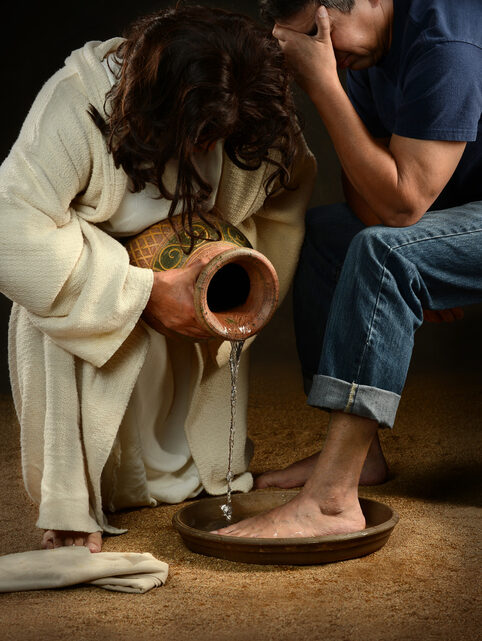
Jesus identified one way to conquer pride. Instead of expecting others to serve us, we must instead serve them. The disciples had witnessed three years of such service from their Master, but He wasn’t through with them yet. John records how Jesus rose and washed the disciples’ feet, as a powerful, final example to them of their need to serve, rather than be served.
Verses for reflection and discussion:
Luke 22:24-27 and John 13:14-15
- Why do you think the sin of pride is so hard to overcome?
- How did Jesus try to teach them the importance of serving others?
- How does serving others help us identify and conquer our pride?
- When have you felt humbled after serving someone else, and what more can and should we all do to keep our desire to serve strong?
Thursday: Look at Him
Jesus served the disciples at their Last Supper together by passing them the bread and wine (declaring them symbols of His flesh and blood about to be shed for them). In addition, the account of John reveals how their Master had even washed their feet before the meal, an act of extreme humility for that time and culture.
Yet even with these final demonstrations of service and humility, the disciples argued over who would have first place in God’s kingdom. Had they kept their eyes solely on Jesus that night, they would have not allowed such prideful thinking and talk to mar the event that Jesus wanted to be so meaningful and sacred.
Paul, in writing to the Philippians, pointed out our need to root out pride from our thinking by meditating on the humility of Christ. Although Jesus was God, He lowered Himself to come in the lowly form of man, so we might see firsthand what it is to be humble and obedient.
Verses for reflection and discussion:
Philippians 2:3-8
- Why was coming to earth as a human so humbling for God’s Son, and why did He do it?
- How can we have the mind of Christ, and what kind of mind was Paul thinking of?
Friday: Final Thoughts
The reason pride is such a stumbling block when it comes to growing our relationship with God is because it causes us to feel capable of handling our own affairs, ignoring our need for Him in our lives. A large part of Christ’s ministry of love and service was to show us the importance of humble attention to the needs of others.
Here are some valuable points to remember as we think about pride versus humility, from the pen of Ellen G. White in The Desire of Ages, pp. 436, 437:
- “The most childlike disciple is the most efficient in labor for God…seeking, not to exalt self, but to save souls.”
- “The simplicity, the self-forgetfulness, and the confiding love of a little child are the attributes that Heaven values.”
- “He places His own signet upon men, not by their rank, not by their wealth, not by their intellectual greatness, but by their oneness with Christ.”
We must remember that we are children of God. Let us all be humble children, recognizing our need for God’s love and care.
Next Week: The Role of the Bible
To read the Sabbath School Lesson Quarterly and see more resources for its study, go to
