















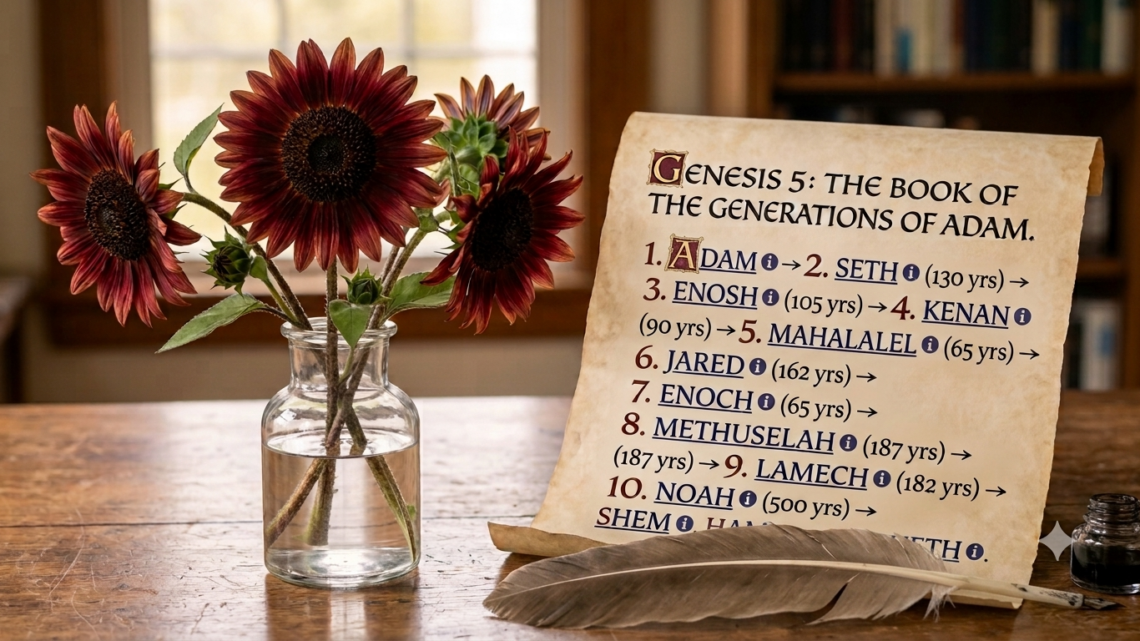
“I want you to pick up sunflower seeds,” my wife said, “—chocolate cherries. Chocolate cherries are seasonal,” she said “so I doubt they’ll have them.” I looked at her confused.
“But it’s Christmas,” I said, “that’s when chocolate cherries are in season.” I often bought them for our son for Christmas. I got out of the car still somewhat bewildered, went into the farm and garden store and returned with a packet of sunflower seeds. “We can buy the chocolate cherries somewhere else,” I said.
My wife shook her head and said, “not at Christmas time.”
It was my turn to shake my head.
My wife got busy on her phone, and finally held up a picture for me. On it was a beautiful large sunflower with maroon petals and a deep brown center. “That’s a chocolate cherry sunflower,” she said, “and they generally only have those seeds in the spring.” My wife had said something very reasonable, but I heard something else, something which made sense to me—it just didn’t happen to be what she was talking about.
That’s a trap we all fall into sometimes when reading the Bible. What we come away with makes sense to us, that has nothing at all to do with what the author meant. That shouldn’t surprise us, considering that the biblical authors wrote in a different cultures, with different languages, and different world views. On the contrary, it would be exceedingly surprising if we saw things in the same way they did.
And genealogies provide one of the clearest examples. We read them largely as a list of names, and when we see ages attached, we treat them as a computation exercise. There are two genealogies in the book of Genesis which have ages attached. Since Adam begins the list, we naturally assume it goes back to creation. For more than two thousand years, people have used those numbers to calculate the age of the earth. It makes a lot of sense.
The genealogy in Genesis 5 says “When Adam had lived 130 years, he fathered a son in his own likeness, according to his image, and named him Seth.” That’s followed by Seth who fathered Enosh at 105 years, Enosh fathered Kenan at 90, and so on for ten generations. That means the earth was also 130 years old at Seth’s birth. Beginning from that point, they add up all the ages in the rest of Genesis 5, And finding the same format in the genealogy in Genesis 11, they proceed to calculate the age of the earth when Abram was born. Eventually they come to the conclusion that the earth must be about 6000 years old today.
The human brain loves it. It seems coherent and it answers a question about which we are naturally curious—the age of the earth. The earth being 6000 years old resonates well, especially when we add the 1000 years mentioned in Revelation — bringing the total to a perfect 7000 years. That makes a very neat package, provided that it matches what the author intended to tell us. And how could we confirm or refute that?
By reading what the author actually said, and asking two basic questions: What did the author actually say? And why did he say it in this specific way?
We’ll go into that next time.