














The numbers are in. According to the Public Religion Research Institute,
38 percent of Americans aged 18 to 29 identify as unchurched, an increase from 32 percent in 2013.
A Gallup survey states that around 57 percent of Americans today seldom or never attend religious services, an increase of 40 percent over 2000. Reporter Robert Conteras states,
“The great unchurching of America comes as identity and reality are increasingly shaped by non-institutional spiritual sources—YouTube mystics, TikTok tarot, digital skeptics, folk saints and AI-generated prayer bots. It’s a tectonic transformation that has profound implications.”1
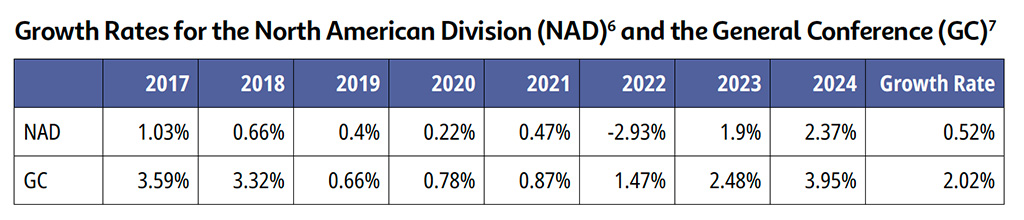
The Adventist Church in North America (NAD) is challenged in the twin areas of church growth and community impact.2 Eight-year growth rates of 0.52 percent in the NAD and just 2 percent worldwide3 were greatly improved upon in 2024 as the NAD saw a growth rate of 2.37 percent and the General Conference 3.95 percent.4 Still churches are challenged to remain relevant to the needs of their communities. The pace of life and the demands of work and family obligations keep people very busy, resulting in a lack of genuine social connections.5
Rapid changes in society have confounded the ways of reaching people, hampering our ability and nimbleness to meet the needs of an ever-increasing secularism and the rise of the “nones.” Pew Research data from 2024 shows that, among the “religiously unaffiliated,” only 17 percent are atheist, leaving 20 percent agnostic and the remaining 63 percent simply “no affiliation.”
This underlines the importance of our ability to adjust our methods in communicating the gospel and ministering to these people.
Reaching the unchurched
Make the church a spiritually vibrant place. If we want the church today to be effective, we need to tap into the power of God that is available to us through prayer. “You shall receive power when the Holy Spirit has come upon you” (Acts 1:8).8
Earthly solutions and human effort, without the power of the Holy Spirit, may produce temporary results but nothing of eternal significance.
However, prayer will bring about eternal results. “A revival need be expected only in answer to prayer. While the people are so destitute of God’s Holy Spirit, they cannot appreciate the preaching of the Word; but when the Spirit’s power touches their hearts, then the discourses given will not be without effect.”9
The disciples experienced firsthand the power of prayer as they gathered together in unity. “And when they had prayed, the place where they were assembled together was shaken; and they were all filled with the Holy Spirit, and they spoke the word of God with boldness” (Acts 4:31).
The early church grew as a result of their effervescent love for Jesus, the urgency of the gospel message, and the power of the Spirit.
When we come into the presence of our Creator, earnestly seeking His face and asking for His Holy Spirit to saturate our hearts and minds, we will see great results for His kingdom. Pastor and author Charles Stanley states,
“The amount of time we spend with Jesus—meditating on His Word and His majesty, seeking His face—establishes our fruitfulness in the kingdom.”10
In the last church I (Joseph) pastored, I tried various types of programming, strategies, and techniques, and the result was a decline in the church. But when I tried prayer, the church became healthy and started to grow. Though it began as a personal effort on my part, eventually it spread like wildfire throughout the congregation. And the Lord added many to the church as this spiritual vibrancy made an impact on the community.
Implement multiple means of engagement. We need to return to the New Testament methods of reaching people, a more comprehensive approach to outreach as outlined in the book of Acts. The believers did public evangelism, proclaiming the truth of the resurrected Christ (Acts 2:4–12), but they also had small group interactions (vv. 42–47) and one-on-one conversations (such as Paul speaking to women at the river; Acts 16) and contextualized the message for their hearers (as Paul did on Mars Hill in Acts 17). They freely proclaimed the gospel message to earthly kings as well as the common people.
The early church operated in both Jewish and Gentile cultures, adapting their methods to the particular worldview of the people to communicate the beauty of the gospel of Jesus.
In all that they did, they did not wait for people to walk in to the church to preach to them. Rather, they seized every opportunity to “go” to others and tell them of the love of Jesus. Today’s church would likely see more fruit from this type of multifaceted approach to evangelism.
In our research for this article, we discovered churches that were doing multiple forms of outreach. Some are traditional, such as offering food and clothing, and others focus on family needs, such as parenting classes, free counseling, supporting single mothers, and teaching English to immigrants.
One church showed up at their local community college on registration day to serve strawberry shortcake to all the students and staff, which resulted in a number of visits to their congregation. The shortcake was just the appetizer before several events that the church offered students throughout the school year. Another church learned of a leukemia patient in their community, and they raised $25,000 for that patient’s family. Led primarily by the youth of the congregation, the church raised awareness and funding through social media, and the story was featured in the local TV news.
Build relationships while meeting the needs of the people.
There is no shortage of problems and suffering that the church can be involved in to relieve people’s burdens. Some traditional examples include clothing and food distribution, while more recent methods incorporate literacy programs, school tutoring, and health and recreation activities. However, when we open our facilities to community groups (Little League, orchestra, or addiction recovery groups), it is almost useless if there is no human engagement with the church members. We must not miss the opportunity to build relationships with those we are serving. As we minister in the name of Jesus, people will benefit from the food we give them, but more importantly, their lives will be changed by the love we show them.
Jesus loved people and mingled freely with them, and that was the secret to His success.
While efforts in our communities often focus on the physical needs of hunger and health care, a deeper need remains for their emotional and spiritual well-being. Ellen G. White calls us to invest our energies into the lives of others by opening our hearts and homes to others.
“There is need of coming close to the people by personal effort. If less time were given to sermonizing, and more time were spent in personal ministry, greater results would be seen. The poor are to be relieved, the sick cared for, the sorrowing and the bereaved comforted, the ignorant instructed, the inexperienced counseled. We are to weep with those that weep, and rejoice with those that rejoice. Accompanied by the power of persuasion, the power of prayer, the power of the love of God, this work will not, cannot, be without fruit.”11
While serving as a pastor some years ago, I (Craig) made it a habit to stop by the cabinet shop owned by the husband of one of our members. His few visits to church over the years had not impressed him that he needed to join, despite his wife’s urgings. My first few visits to his shop were casual and brief, and I wondered what, if any, effect my efforts were making. Over time, as we became better acquainted, the conversations were more engaging. Naturally, the more we connected, the more the conversation turned to important matters of life and spirituality. I remember rejoicing when he expressed interest in Bible studies, which we did along with his wife and teenage daughter. What a day for the entire church family when he was eventually baptized.
Share your testimony of a changed life.
While the church continues its old methods of proclamation, the need grows for sharing the life-changing experience of knowing Jesus through friendship evangelism and acts of loving service. The eyes of the world need to clearly see the difference that Jesus makes in the lives of His followers. But for them to want it, they need to grasp the power of the gospel that transforms lives, providing hope and significance. When Jesus healed a demon-possessed man, He gave him a special task of sharing his experience with those close to him. “Jesus sent him away, saying, ‘Return to your own house, and tell what great things God has done for you.’ And he went his way and proclaimed throughout the whole city what great things Jesus had done for him” (Luke 8:38, 39).
The apostle Paul repeatedly shared the story of his changed life. Your story never gets old as you share it with someone new, and each time you tell it, you will feel a renewed gratitude to God. When hearing that your story transformed someone’s life, it is a great source of renewed encouragement. David shares his story in the Psalms, repeatedly describing how dark his life had been and how much better it was with God.
In one sharing of my (Joe’s) story at a church, in the audience was a woman who had resisted making the commitment to be baptized. Her husband was a member, but she had come out of a non-Christian background and was fearful of how her family would react to her decision to follow Jesus. She feared the abandonment and persecution she would face from her family. She heard my story of how God brought my family full circle from resistance, persecution, and even physically beating me to a place of acceptance, and some of them even joining in faith, and God used my testimony to encourage her. On the day of her baptism, she declared that she knew God would be with her and protect her in her faith journey.
Love and care
In this article we have discussed the challenges the church faces as it relates to the major cultural shift from Christianity to secularism. In the past, converts to the church were mainly from other denominations, whereas today’s society is mostly non-Christian and unchurched. The role of the church in the daily lives of people has become less and less significant.
Effectiveness in outreach is less about the programs offered and more about the personal involvement and connection of members with others. “
From Christ’s methods of labor we may learn many valuable lessons. He did not follow merely one method; in various ways He sought to gain the attention of the multitude; and then He proclaimed to them the truths of the gospel.”12 Following the example of Jesus, effective churches will serve their communities in a variety of ways that meet real needs.
Contreras concludes, “The old religious map is disappearing. The new one—digital, more secular, decentralized and deeply fragmented—is only beginning to take shape.”13
Therefore, the most important thing a church can offer its community is genuine love and care. Ellen G. White states, “The world will be convinced, not by what the pulpit teaches, but by what the church lives.”14 Indeed, all of our efforts—to make the church vibrant, to engage the community in multiple ways, building relationships with others, and sharing our testimony—would be in vain without prayer and the power of the Holy Spirit.
By Craig Carr, DMin, Ministerial and Evangelism Director of the Mid-America Union Conference in Lincoln, Nebraska; and S. Joseph Kidder, DMin, Professor of Discipleship and Applied Theology at the Seventh-day Adventist Theological Seminary, Andrews University, in Berrien Springs, Michigan.
This article was originally published in the February 2026 issue of Ministry Magazine.
- Russell Contreras, “The Great Unchurching of America,” Axios, Dec. 26, 2025.
- From 2011 to 2016, the growth rate for the Seventh-day Adventist Church in North America averaged 1.5 percent, but from 2017 to 2021 it dropped to 0.56 percent, a decrease that began before the global pandemic.
- During 2019–2021, the world church has also seen a declining growth rate of below 1 percent, with 2021 below 0.87 percent. See General Conference statistics in the table “Sub Field Data for 2024,” ASTR, https://www.adventiststatistics.org/view_Summary.asp?FieldAbr=GC.
- Becky St. Clair, “God’s Enduring Presence: Secretary’s Report at the 2025 North American Division Year-End Meeting,” North American Division of Seventh-day Adventists News, Nov. 7, 2025, https://www.nadadventist.org/news/godsenduring-presence-secretarys-report-at-the-2025-north-american-division-year-end-meeting/.
- In his 2021 report to the General Conference Fall Council, archivist David Trim claimed that the “COVID-19 pandemic lockdowns likely contributed to this decline.” However, “he believes that another potential factor is a decline in personal evangelism, which he labeled ‘the crucial importance of interpersonal contact.’ ” Michael Gryboski, ed., “Seventh-day= Adventist Church Experiences Lowest Rate of Growth in 16 Years,” Christian Post, Oct. 13, 2021, https://www.christianpost.com/news/seventh-day-adventists-have-lowest-growth-in-16-years.html.
- “North American Division (1913–Present): Sub Field Data for 2024,” ASTR, accessed Jan. 5, 2026, https://www.adventiststatistics.org/view_Summary.asp?FieldAbr=NAD.
- “General Conference (1901–Present): Sub Field Data for 2024,” ASTR, accessed Jan. 5, 2026, https://www.adventiststatistics.org/view_Summary.asp?FieldAbr=GC.
- Scripture references in this article are from the New King James Version (NKJV).
- Ellen G. White, Selected Messages, book 1 (Washington, DC: Review and Herald Pub. Assn., 1958), 121.
- 10 Charles F. Stanley, How to Listen to God (Nashville, TN: Thomas Nelson, 2002), 101.
- Ellen G. White, The Ministry of Healing (Mountain View, CA: Pacific Press Pub. Assn., 1942), 143, 144. See also Rodney Stark, The Rise of Christianity: How the Obscure, Marginal Jesus Movement Became the Dominant Religious Force in the Western World in a Few Centuries (San Francisco, CA: Harper Collins, 1997), 161.
- Ellen G. White, Evangelism (Washington, DC: Review and Herald Pub. Assn., 1946), 123.
- Contreras, “Great Unchurching.”
- 1Ellen G. White, Testimonies for the Church, vol. 7 (Mountain View, CA: Pacific Press Pub. Assn., 1948), 16.

No Comment