














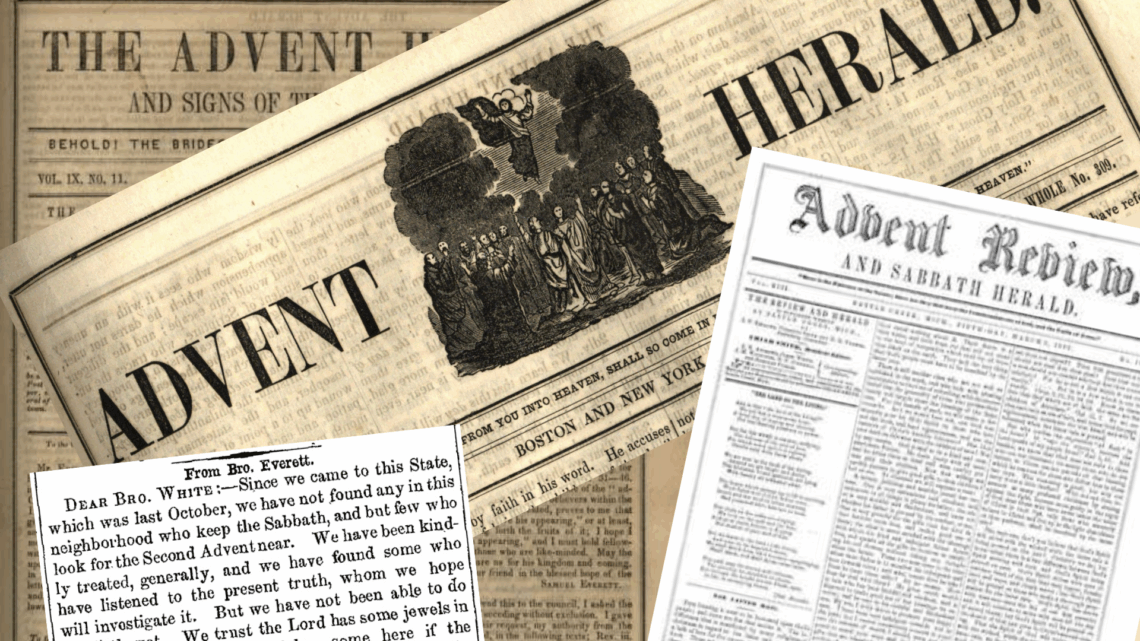
In 2026 I will be exploring early Sabbatarian Adventists in the states that now comprise the Mid-America Union. There is no way to know who the first Millerite or Adventist was in each state. Instead, I will feature the first people to write to the Advent Review and Sabbath Herald (forerunner of the Adventist Review) from the territories or states in what is now the Mid-America Union.
Baptist Minister
Samuel Everett was a third cousin, once removed to Edward Everett, the famous politician and orator who spoke before Abraham Lincoln at the dedication of the Gettysburg Cemetery National Cemetery on November 19, 1863. The author Edward Everett Hale was his fourth cousin. Samuel Everett, however, lived a humbler life than those of his more exalted relatives.
Born on October 11, 1793, in Princeton, Massachusetts, to Joshua Everett and Ruth Wood, Samuel Everett experienced a conversion to Christianity in 1818 after which he felt the call to ministry. He attended the Baptist college in Waterville, Maine, where he enrolled in theology classes. (Then known as Waterville College, it became Colby College in 1867.) Everett graduated in 1823.
By the time he married Lucinda Keyes* (September 14, 1798-January 9, 1868), in his home town of Princeton, Massachusetts, on February 9, 1825, he was the pastor of a Baptist congregation in Milford, New Hampshire. While in Milford, Everett was ordained and the couple’s first three children were born. In 1832, Everett was called to the church in Salisbury, New Hampshire. Three more children joined the family there. Everett became the Baptist minister in Holden, Massachusetts, in 1838, and a little more than a year later the family moved to North Leverett, Massachusetts, where they remained until 1852.
From Millerite to Sabbatarian Adventist
In early 1843 Samuel Everett joined the Millerite movement, accompanied by at least his wife and daughter. By early 1845, he was in conflict with his Baptist congregation and denominational leadership. The immediate flashpoint was Everett’s officiation of an open communion service in which unbaptized attendees were invited to participate. When Baptist leadership sought to discipline him, he “seceded” from the denomination. His stated reasons were that the Baptists had become proud and worldly in their wealth and increasing numbers. They resisted reform, and he no longer agreed with Baptist teaching in regard to eschatology and Jesus’ second advent.
I joined the Baptist church from choice and from a conviction of duty, and I left it from a conviction of duty. I could never again join any church in its imperfect state on earth, where the right of secession for conscience sake is denied. The church was never intended to be a prison to the saints, but a voluntary company of brethren, bound together “in faith and love in Christ Jesus.”(“Secession”).
Everett probably supported his family through farming, but curiously the 1850 U. S. Census still lists his occupation as a Baptist minister. According to the Millerite periodical, The Advent Herald and Morning Watch, he was involved in at least one weekend Bible conference of the many held in various homes during this period. Over a year after leaving the Baptist denomination, he was still concerned about the spiritual state of Advent believers who remained in organized denominations.
We are glad to know that there are still some brethren who love the appearing of the Lord among our opponents…One, not long since, expressed the opinion that we have been hasty in seceding. I think not. We did not take such a course, till we saw that “the advent near” was rejected by them, as a body,—Even then, some of us waited for months, loth to leave and to give over our labors for their good. (Letter from Bro. S. Everett)
Everett’s separation from the denomination for which he had labored so many years was difficult in many ways. Yet, his letters of the late 1840s call for a loving, brotherly spirit among the Advent believers.
Everett did not give the seventh-day Sabbath as one of his reasons for leaving the Baptist denomination, but in April 1852, he wrote a letter to the Advent Review and Sabbath Herald outlining biblical support for it (“From Bro. Everett”). In July he announced that he would be meeting with seventh-day-keeping Advent believers in Bennington, New Hampshire, and Munsonville (probably in New Hampshire, although New York is a possibility, although there is no record of Everett preaching in New York) on two successive weekends in mid-summer. The next time Everett wrote to the Review, he, Lucinda, and their twelve-year-son, William Stillman (1837-1881), had moved to Iowa City, Iowa.
Life in Iowa
A desire to spread “present truth” seems to have been Everett’s motivation for moving to Iowa at the age of fifty-nine in October of 1852 (“From Bro. Everett”). In Massachusetts the Everetts left behind a host of family, friends, and acquaintances, including their oldest son, Samuel Pearce (or Pierce), and daughter, Lucinda Elizabeth (1829-1853) known as Elizabeth to avoid confusion with her mother. Three of their six children, Joshua Titus (1827-1846), Mary Jane (1832-1834), and George Boardman (1835-1836), had already died. Lucinda Elizabeth married Whitman Fiske Higgins in 1849, but died on July 5, 1853, before having any children of her own. Lucinda wrote a lengthy and touching tribute to her daughter, published in the Adventist Review and Sabbath Herald on October 11, 1853. Elizabeth’s death contributed to the great loneliness that her parents mentioned in their correspondence with the Review. Near the end of her tribute to Elizabeth, Lucinda wrote:
The loss to us is great. We are a lonely family with but few to keep the Sabbath or tell of the coming of the Lord. We need much wisdom and grace; and I trust we shall have the sympathy and prayers of the brethren and sisters who may read these lines. We are waiting to hear what the Lord will speak to us, and what he would have us do (“From Sister Everett”).
In 1856, about the time well-known Adventist families such as the Stevenses and Andrews were moving to Waukon, Iowa, and lesser-known people such as J. Blain of Dubuque, Iowa, and Alvarez Pierce of Hardin County, Iowa, began writing to the Review, Everett reported from Iowa City,
We have several Sabbath-keepers in Iowa, but they are few and far between as yet. When we first came to this State, we did not know of any others but our family. But the emigration to the West is bringing some. We need them all over the State to reprove Sunday-keepers and Sunday-breakers, and to hold up the light of present truth.
We want a single young brother to live with us at present, who loves the Sabbath of the Lord, and would like to live in the West. Such a one can write us on reading this. We would be glad to receive a communication from him. May the Lord strengthen you to perform your arduous labor of love (Advent Review and Sabbath Herald).
There is no record whether such a young man accepted their invitation. By 1860 William was married with a family, living on his own farm in Johnson County, Iowa. Samuel and Lucinda lived with him. From here the picture of their lives becomes murkier.
Parting Ways with the Seventh-day Adventists
Everett was known for his “heavenly discourse” and “his complete devotion to the work of the Master.” Until his death in 1875, according to his obituary, he continued to preach in Iowa and Michigan. (The Greenfield, Massachusetts, Recorder, November 8, 1875). In 1854, he had published a very strong article in the Review on the importance of the Ten Commandments (“The Law of God and Other Laws Not Abolished”). In 1856, he shared decidedly anti-violence opinions about the fighting in “Bleeding Kansas” (“From Bro. Everett”). Yet, in June 1859 at a meeting led by Elders Merritt Eaton Cornell and Moses Hull in Iowa City, Samuel Everett was disfellowshipped for conducting secular business on the Sabbath, something that seems completely of out character for him. In making his defense, he claimed that he was being disfellowshipped for not believing Ellen G. White’s visions. He was told this was not a test of fellowship, but that they could not condone his criticism of people who did believe her visions (“Conference at Iowa City”). Everett continued to support the Advent Review and Sabbath Herald into 1860, but thereafter disappeared from Seventh-day Adventist publications.
Why Samuel and Lucinda moved to Michigan in the 1860s, when they were at an advanced age and where they had no known family, is a complete mystery. While Everett seemed to maintain a regular speaking itinerary, to whom he spoke is unknown. The 1870 U. S. Census (at which time Everett was residing with this oldest son in Massachusetts) indicated his occupation was “Elder of the 2nd Adventists.” Given his opposition to organized denominations, this may mean that he joined the Life and Advent Union, one of the smaller groups to arise from the Millerite movement, which opposed centralized organization and taught conditional immortality of the soul (something Everett definitely believed). William stayed on his farm in Iowa where he died in 1881. Samuel Pearce remained in Massachusetts where his career ranged from teaching to state legislator, and finally a Baptist preacher. The first-born son, he also lived the longest of all their children, dying in 1908. When Lucinda died in Hartford, Van Buren County, Michigan, on January 9, 1868, her death record recorded her occupation as teacher. Samuel Everett died on September 22, 1875, in Cheshire Township, Allegan County, Michigan. His body was taken to Hartford, Michigan, where he was buried beside Lucinda.
*Lucinda Keyes was the oldest daughter of Solomon Keyes and Betsey Rand. Solomon was a brother to Lucy Keyes, whose disappearance from Princeton, Massachusetts, in 1755 when she was four years old is a legendary unsolved mystery that has inspired many stories and theories.

No Comment