















Sabbath School Lesson for October 18-24, 2025
Introduction of Lesson 4, The Conflict Behind All Conflicts
Memory Text: “There has been no day like it before or since, when the Lord heeded the voice of a man, for the Lord fought for Israel.” Joshua 10:14 ESV
It’s easy to see the grace of God when we read some stories in the book of Joshua, such as when the lives of Rahab’s family and the Gibeonites were spared. Much of Joshua’s account, however, involves violent wars of conquest ordered by God to be carried out against the tribes that had long refused to repent of their despicable crimes against God and their own populations.
At times, the fighting consisted merely of watching the Lord miraculously eliminate their enemies. This kind of passive fighting, as seen when the Red Sea swallowed up Pharaoh’s pursuing army of charioteers, was thankfully repeated at various times when they finally reached Canaan.
There is a lot to be gained by looking at the conflict that underscores all these battles–the great controversy between Christ and Satan, between the forces of good and evil. These divinely commanded battles in Joshua can best be understood in the context of the much larger conflict still raging and how God is forced to deal with the evil that Lucifer, now called Satan, has inflicted on our tiny planet.
- Sunday: Commander of the Army of the Lord
- Monday: War in Heaven
- Tuesday: The Lord Is a Warrior
- Wednesday: The Lord Will Fight for You
- Thursday: The Second-Best Option
Sunday: Commander of the Army of the Lord
The crossing of the Jordan River on dry ground served a two-fold purpose. It showed the Israelites that God was with them in whatever lay ahead in Canaan, and was thus a great faith-builder for His people. But it also was one of the many opportunities the Canaanite tribes were given over hundreds of years to see God’s power and worship the Lord, instead of their pagan deities.
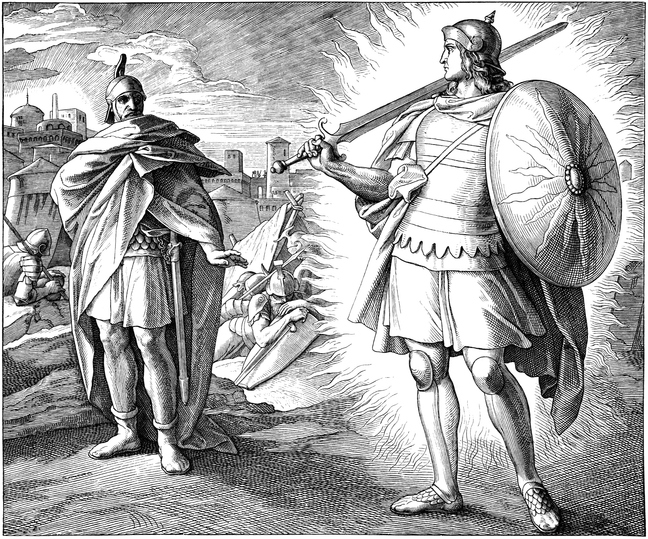
Joshua, as leader of the small, ill-equipped Hebrew army, was given further reason to believe God was in charge. When they were close to Jericho, a highly-fortified city, someone who described Himself as the “Commander of the army of the Lord” appeared before him (Joshua 5:13-15). This imposing war-like figure, brandishing a sword, was soon recognized by Joshua as someone equal to God, because Joshua immediately bowed down in a posture of humility and worship before Him.
This welcome manifestation of God’s presence was not to verify if God was on Joshua’s side. That was apparent enough. The real question may have been to verify that Joshua was on the Lord’s side. Joshua was given another chance to declare his commitment to follow God’s instructions.
Verses and questions:
Joshua 5:13-15, Nehemiah 9:6, and Isaiah 37:16
- What do these verses tell us about the identity of the supernatural being Joshua saw near Jericho?
- How would Joshua have been encouraged and strengthened by his encounter with the “Commander of the hosts”?
Monday: War in Heaven
We find in Revelation 12:7-9 the most definitive evidence for a war in heaven, and what it meant for those who listened to Lucifer’s lies about God’s character. The consequence was for Lucifer, who became known later as Satan, to be cast out of heaven by force, along with one-third of the heavenly angels who sided with him.
This conflict of universal consequence was also hinted at though, even in the Old Testament. Isaiah and Ezekiel spoke about kings of Babylon and Tyre, but they were also obviously speaking about a more transcendent reality–the crimes committed by Satan against God. See Isaiah 14:12-14 and Ezekiel 28:11-19.
The divinely-appointed wars Joshua was instructed to carry out in Canaan were an extension of God’s purpose to save the world from utter destruction. Sometimes God must put a stop to evil, when all efforts to redeem the people involved had failed, as it had with the pagan tribes in Canaan. With so many involved in wickedness there, the result of God not intervening would not have been a viable option at the time.
Verses and questions:
Revelation 12:7-9
- Why was Lucifer cast out of heaven?
- Why wasn’t Lucifer and the angels who followed him destroyed at that time?
Isaiah 14:12-14 and Ezekiel 28:11-19
- How do these verses hint at a great cosmic conflict?
Tuesday: The Lord Is a Warrior
In the ancient Near East, wars were not just conflicts between peoples, but the gods they worshipped. They were actually fighting for the reputation of their chosen god. The Hebrews had seen the plagues back in Egypt as evidence that the God of Abraham was superior to the gods of the Nile, the fertility gods, and all the other deities prominent in that culture.
Exodus 15:3 exposes the Lord as a “man of war”. And Revelation 19:11 pictures Christ on a white horse while He judges and “makes war” with the forces of evil. Psalm 24:8 verifies that “the Lord is strong and mighty…mighty in battle”. Yes, God is at war with sin.
The elimination of the Canaan tribes who opposed God was a preview of the final judgment, when God will take down the forces of evil once and for all. Today, each of us must chose which side we are on in this conflict. The choice has eternal consequences, both good and bad ones.
Verses and questions:
Exodus 15:3-11
- How does God use His warlike power to wage war against Satan and His enemies?
Revelation 19:11 and Psalm 24:8
- How do these verses help us see God’s role in all the bloody battles described in Joshua’s account?
Wednesday: The Lord Will Fight for You
When the Israelites became afraid that the Egyptian chariots were about to overtake them as they left Egypt, Moses reminded them that they should stand still, because the Lord would fight for them (Exodus 14:12-14).
As it happened, even the Egyptians soon saw the truth in Moses’ words. They said, “Let us flee from the face of Israel, for the Lord fights for them against the Egyptians” (Exodus 14:25). This event foretold of a similar time when the unrighteous will bow down and proclaim that Jesus Christ is Lord (Philippians 2:10-11). They will acknowledge that they have been defeated by God, despite their best efforts to overtake God’s heavenly city, New Jerusalem.
Of course, God’s ideal strategy was for Him to do all the fighting for His people. But as the Israelites struggled so often with their faith, God many times instructed them to participate in the “dirty work” of battling their enemies. In this way, perhaps they would have a closer, personal experience with death to remind them of the consequences of not following God. It also may have given them an opportunity to work more directly with God, strengthening their relationship with Him.
Verses and questions:
Exodus 14:13, 14, 25
- What is God’s ideal way to defeat His enemies?
- Why did Joshua’s army often have to do the fighting, along with God?
Thursday: The Second-Best Option
After all the miraculous victories the Israelites had witnessed, we realize that God’s original plan was for Him to do all the fighting against the evil forces that threatened His people. However, they often showed a stubborn lack of faith and began to murmur, which called for God to change His strategy to include them in the actual fighting.
This happened when the Amalekites attacked the Hebrews shortly after God used Moses to supply their water by striking a rock with his rod. The Israelites found they were winning the battle against the Amalekites only when that rod in Moses’ arms were raised in prayer for God’s help.
A similar situation of human/divine effort was seen outside the fortified city of Jericho. The walls of the city miraculously fell down after they marched around them seven times and the priests blew their trumpets. It was then required that they enter the frightened city and kill and destroy all but Rahab’s family there. Their personal involvement in winning the battle would hopefully build a more steadfast trust in the Lord’s help.
Verses and questions:
Exodus 17:7-13
- How and why was there this combination of human and divine effort in defeating the Amalekites?
Joshua 6:15-20
- What similarities were there with this story of victory and the one under Moses’ leadership?
- How might God have worked to prevent them from having to do the killing in Jericho, and why might God have chosen this other plan?
Friday: Final Thoughts
You may or may not have heard of the word “theodicy”. It is simply the vindication of God’s divine goodness in view of the evil that also exists in the universe. Why do bad things happen to good people is a question that periodically baffles the mind of almost everyone on this planet earth. Understanding the great conflict between Christ and Satan is vital in knowing the answer to this question.
It’s difficult to reconcile in our minds how a God of love could call for the death of so many in the book of Joshua. But it was thought to be wise King Solomon who reminded us that there is a time for everything. Ecclesiastes 3:3, 8 tells us that there is a time to kill and a time to heal, a time of war and a time of peace. Only by trusting God and following His instructions will we know when those times are.
God is for us and Satan is against us, and we have the freedom to choose which one we will serve. This is the essence of the three angels’ messages in Revelation 14. Let’s constantly be aware that we are in a battle of good versus evil and our daily choices will determine our final destiny, just like it did for the Canaanite tribes and the Hebrews.
Next Week: God Fights for You
To read the Sabbath School Lesson Quarterly and see more resources for its study, go to

No Comment