











Sabbath School Lesson for October 4-10, 2025
Introduction of Lesson 2, Surprised by Grace
Memory Text: “By faith the harlot Rahab did not perish with those who did not believe, when she had received the spies with peace.” Hebrews 11:31 NKJV
Several familiar stories in the book of Joshua surprise us with the broad scope of God’s amazing grace. They are powerful testimonies of the Lord being the God of second chances. The stories involved spies, and how much grace God has for those who repent. His tent of forgiveness is large enough for the most unexpected guests.
With all the killing and fighting that was necessary for God’s people to enter and inhabit the land promised to them by God, it’s encouraging to know that He gave plenty of time for the pagan tribes to repent before their destruction. His amazing love was never separate from His fair and humane justice.
Even the Israelites, and Joshua himself, still made mistakes along the way. They needed many second chances, too. God’s support was needed for their victory, but so was their willing cooperation with God’s plans. When we, through faith, work with and for God, we also will be amazed by the grace that works in our lives.
- Sunday: Second Chances
- Monday: Value in Unexpected Places
- Tuesday: New Allegiance
- Wednesday: Conflicting Values
- Thursday: Surprising Grace
Sunday: Second Chances
For those who hear Joshua’s story today, we are reminded how someone in Jesus’ close-knit group of twelve disciples was given a second chance in a very public, profound way. Peter’s faith crumbled after his Master’s arrest. Precisely as Christ had predicted, overconfident Simon Peter ended up denying his Lord three times before a cock crowed. But after Christ’s resurrection, Peter’s relationship with the Lord was restored, when he was allowed to express his love for Jesus three times.
Sending two spies out from the place called Acacia Grove must have created some initial tension for Joshua and the Israelites. He and Caleb had been included in the earlier group of twelve men sent out to spy in Canaan when they were under Moses’ leadership. That episode had been relayed from parent to child ever since. Lack of faith caused a heavy price for God’s people, resulting in forty years of wearisome, wilderness travel.
One can only guess why only two spies were sent out this time, and not twelve like before. Perhaps they were more confident in the outcome this time, or more united. In any event, sending in spies for last minute information-gathering purposes often seemed to be part of God’s careful planning. We recall how God sent angels to Sodom before its destruction to see if anyone there still had faith. He makes sure we are given every chance to repent.
Verses and Questions:
Joshua 2:1 and Numbers 13:1, 2, 25-28, 33
- Why would it still prove helpful for spies to be sent into Jericho, and why do you think just two, instead of twelve?
John 18:25-27, 21:17 and Ephesians 2:8
- How does this show us that being forgiven is a gift of grace none of us deserve?
- Why does God keep giving us so many chances, and how does this apply to my need to forgive others?
- How can we possibly forgive like God does, and why is it necessary?
Monday: Value in Unexpected Places
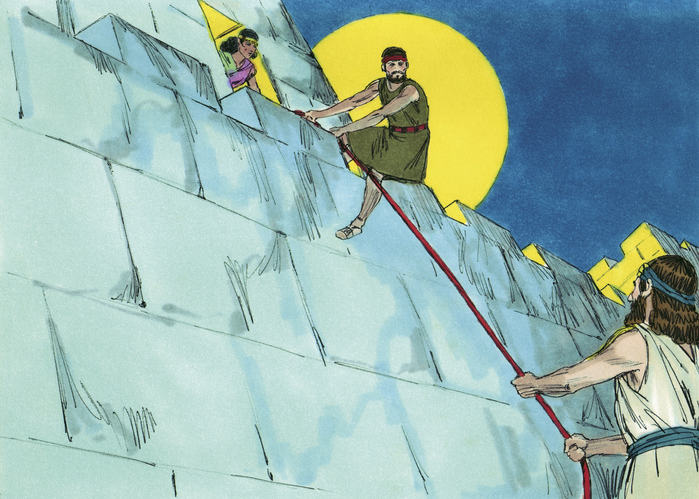
Living in a very corrupt society, and having a sinful reputation herself, Rahab nevertheless had a glimmer of faith in God when she risked her own life to save the lives of two spies, sent by Joshua to gather information about the city of Jericho. Although her method of help included telling a lie, God honored her efforts to save the lives of the spies who had sought refuge in her household.
Her quick, brave actions, later allowed her and her family to escape the destruction of the place they had called home. She courageously made a conscious effort to place herself on the side of a merciful God that she had chosen to follow.
God honored her act of faith, causing her to be mentioned in the book of Hebrews as an example of faith, and even be included in the genealogy of Christ, as the mother of Boaz (Matthew 1:5).
Verses and questions:
Joshua 2:2-13, Hebrews 11:31, and James 2:25
- What is the value of our works when it comes to carrying out the plans of God?
- Why must faith still be included in our efforts?
- What does this story tell us about the level of our commitment to God, even before we know very much about Him?
Tuesday: New Allegiance
The word that Rahab used to describe her actions–“loving-kindness”–is rich in meaning in this context (Joshua 2:12). It denotes all the faithfulness, mercy, and loyalty that one finds in a covenantal relationship.
Allowing a scarlet cord to remain in her window to show her emerging faith reminds us of the Passover. This was a time when the Hebrews, still slaves under Pharoah, were told to remain in their homes and have the red blood of a lamb visible on their doorposts, so the angel of death would pass over their houses.
Although we are saved by faith, God requires that our faith be shown by our works. Our deeds are evidence of our faith in God. Like Rahab, we must obey the directions of the One we have come to trust. Our faith grows as we choose to exercise it by being obedient, like the humble, faithful Canaanite woman in Joshua’s story.
Verses and questions:
Joshua 2:12-31 and Exodus 12:13, 22, 23
- In what way are these stories similar?
- What is necessary for us to grow our faith and remain loyal to God?
Wednesday: Conflicting Values
Joshua, chapter 9, brings us to another episode in the conquest of Canaan that involved spies. To their credit, the Gibeonites sought to establish a covenant of peace with Israel, instead of joining the coalition of city-states in Canaan who were working against the Israelites. But their method of extracting such a self-serving covenant from the people they had come to fear was less than honest.
The Gibeonites sent ambassadors to Joshua’s people, dressed as if they had come from a country far away. When questioned about their identity, they lied about it to make themselves appear less dangerous.
If Joshua and the leaders of Israel had asked the Lord for discernment and guidance in this unusual situation, they might have saved themselves a lot of trouble. Likewise, it is expedient for us to always inquire what the will of God is before making important life-changing decisions.
Verses and questions:
Joshua 9:1-20
- What similarities and differences do you see in the story of Rahab and the story of the Gibeonites?
- What can we learn from Joshua’s mistake of not asking God what we should do?
Thursday: Surprising Grace
Despite it being an unwise, rash oath, and extracted under false pretense and subterfuge, the Israelites felt it was their obligation not destroy the Gibeonites in the coming conquest.
After discovering the correct, close location of the Gibeonite tribe, however, they determined that their newfound partners would indeed be their servants, as the ambassadors declared themselves to be. They would be woodcutters and water carriers for the house of the Lord from that time on.
What may have seemed like a curse at first for the Gibeonites, actually turned out to be a blessing. Working so close to the tabernacle led them to give up their idolatry and follow instead the God of the Hebrews. As a matter of fact, later when the Israelites returned from their Babylonian captivity, it was the Gibeonites who helped rebuild Jerusalem (Nehemiah 7:25).
Verses and questions:
Joshua 9:21-27 and Nehemiah 7:25
- How was Joshua’s solution a combination of justice and grace?
- How did their compelled servitude as woodcutters and water carriers turn out to be a blessing for the Gibeonites?
Friday: Final Thoughts
The discovery that Rahab, a lowly Canaanite woman, and the Gibeonites, a pagan tribe, both became vital contributors to the success of Israel is a powerful testimony of God’s desire to be “a house of prayer for all nations” (Isaiah 56:7). All were given, upon their repentance, the full blessings of the covenant given to Abraham.
This shows us that God’s intent, even for His chosen people back then, was for them to be a welcoming beacon of hope for all those around them. We should, therefore, be delighted to pray not just for our own nation, but for the entire world. Many today seem to have forgotten John 3:16, the most beloved verse in the entire Bible: “For God so loved the WORLD…”
Prophets and Kings, p. 370, tells us, “Christ came to demolish every wall of partition, to throw open every compartment of the temple courts, that every soul may have free access to God.” On our own, we often tend to build walls that separate us, but it is our loving God’s plan to tear them down.
Next Week: Memorials of Grace
To read the Sabbath School Lesson Quarterly and see more resources for its study, go to
