













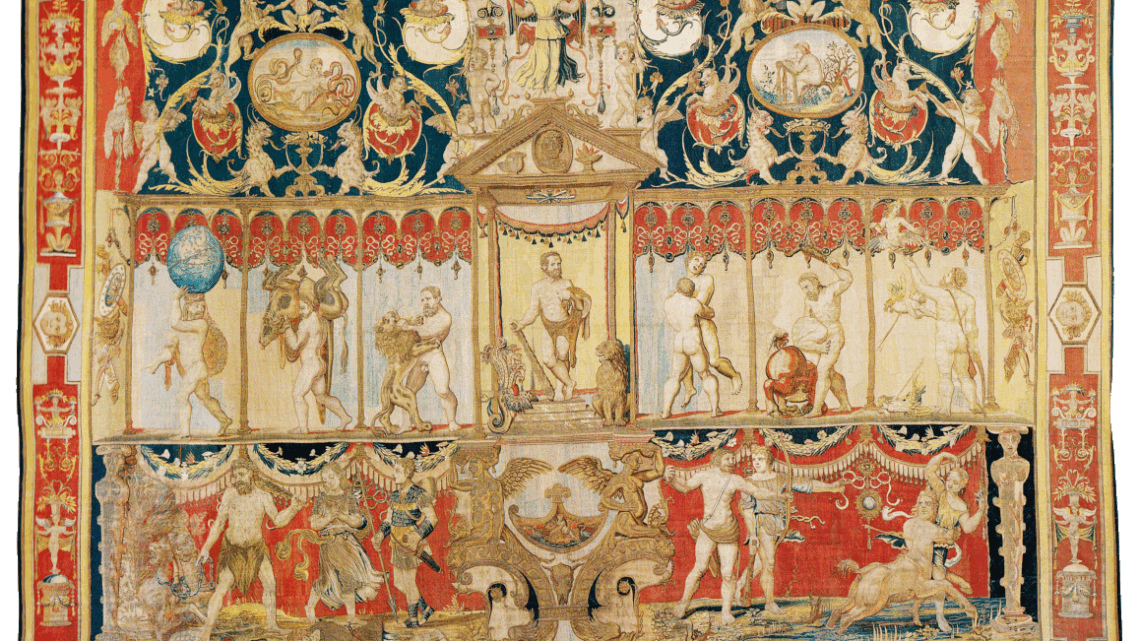
Last time we looked at the Bible as a majestic tapestry depicting all the great events in the entire book. Then we noted that much of what we call “Bible studies” really consist of Topical studies which cite Bible texts, and we compared that to someone snipping out pieces of the tapestry and reweaving them into their own creation, something like a quilt. And we noted that although the quilt contained parts of the grand tapestry, it was in fact the product of the mind the quilter, and not that of the Master Weaver.
So how does a “Bible study” differ from the topical study? And how do we find the proper interpretation of revelation chapter 13? Because we’re interested in this specific chapter—think of it as a scene or a tableau—of a larger composition, we will focus on that part of the tapestry. When we do that, we see that the beast with the lamblike horns belongs to a larger scene which goes back to the beginning of chapter 12.
This in turn belongs to one of these 7 main divisions of the entire Book of Revelation. Looking at the entire display, we see this space filled with the great variety of images, many of them bizarre and disturbing. This leaves us with two choices: we can decide to try and decode these symbolic images using our own intuition and logic, or we can see if the author of the text has given us indications of how these things should be interpreted.
Considering that the author was inspired and the interpreter is not, clearly the author’s intended method of interpretation should take priority. When it comes to the Book of Revelation, we see that it was written on the Isle of Patmos where John was a prisoner. If the Book of Revelation Contained any indications that the Roman Empire would not last forever, The Roman authorities would consider that treasonous and would not have allowed that message to leave the island.
Knowing that, John could not state the key the symbols outright, but instead would have left indications that his audience could understand but the Romans would not. And as we examine that part of the tapestry, we find precisely that.
We see the clues first in the beginning of the section portraying Revelation, but soon we see them all over. Images which remind us of similar images in other places on the Great Tapestry: A man dressed like a priest, golden lampstands, a golden altar. Looking back to earlier scenes, we see the same images. The Tabernacle and its furnishings, back in the books of Moses. And there are other images as well. In Revelation, we see four “living creatures,” with faces just like the images on the banners of the tribes surrounding the Sanctuary encampment.
John has left a key that anyone familiar with the Old Testament, the early images on the tapestry, will recognize, but which will appear bizarre and chaotic to anyone else. His Roman keepers have no reason to censor what they may consider the ravings of a stir-crazy prisoner.
The more we look at the book of Revelation, the more images resembling the Old Testament portion of the tapestry we see. This tells us that the Old Testament, and especially the Tabernacle, furnishes the key to understanding the symbols in Revelation. Revelation chapter 13, the focus of the passage we are exploring, begins with a beast that resembles a leopard, has the feet of a bear, the mouth of a lion, and has seven heads and ten horns like the dragon which gives it power.
Looking back, we find that this beast is a composite of the beasts, heads, and horns portrayed in Daniel, chapter 7. Whatever interpretation we make concerning the beast with the lamb-like horns, must be in harmony with these elaborate references to the Old Testament.
There are multiple more references that a thorough job of interpretation would require, but by now the difference between the topical approach and a true Bible study should be clear.
In the topical approach, we begin with the conclusion and begin compiling evidence; a true Bible study looks at the immediate context—in our case the polyglot beast in chapter 13—and the larger context of the whole of the book of Revelation, and how the beast with the lamb-like horns should be interpreted based on the author’s intended method.
Every interpretation can be distorted by confirmation bias, but the safeguards built into the true Bible study approach are robust, while largely missing from the topical approach.
Please note, I am not saying whether the traditional interpretation of this passage is correct or incorrect. Demonstrating the different approaches to interpretation is my only purpose. Also, I am not saying that the topical approach is always false, only that topical studies differ in approach from true Bible study. I am saying that the only way to understand the purpose of the Master Weaver, indeed, to come to know the Master, is to study the Grand Tapestry as a whole. Someone else’s quilt may be accurate and true, but the Grand Tapestry offers a far more beautiful, deeper, and rewarding experience.
Revelation, because of its highly symbolic composition, provides one of the most challenging books to interpret. We turn next to a less symbolic text, the gospel of Mark.