















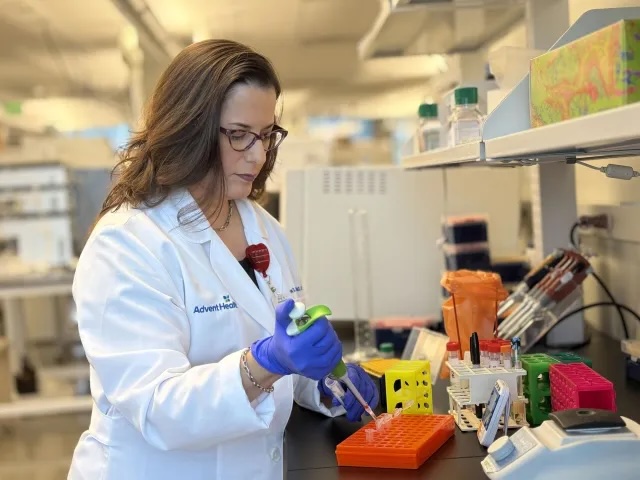
Calories aren’t as straightforward as food labels suggest, according to research from the AdventHealth Translational Research Institute. Karen Corbin, Ph.D., recently shared on “The Proof with Simon Hill” podcast how the gut microbiome plays a meaningful role in how much energy your body actually absorbs from food.
Understanding the gut helps shift the focus from counting calories to caring for the whole person. The research uncovered a few key highlights:
- Whole food diets can reduce calorie absorption from foods.
In a trial conducted at AdventHealth, people following a fiber-rich, whole foods diet absorbed an average of 116 fewer calories each day as compared to a diet that was low in fiber —even though they consumed the same amount of calories on both diets. That’s because some of the energy fed their gut microbes and was excreted rather than stored. - Fiber helps your body work smarter, not harder.
High fiber, whole food diets don’t just support digestion. They can also influence fullness cues, blood sugar regulation, body weight, liver and overall metabolic health, often within weeks. While fiber is an essential nutrient in our daily diet, how much you need to eat depends on several factors, including age and sex. On average, the recommended daily fiber intake is 22 to 28 grams for women and 25 to 38 grams for men. - “Feed your gut” is a simple daily health check.
Corbin encourages asking this question each day: Have I fed my gut microbiome? Fruits, vegetables, whole grains and beans help nourish the microbes that support whole-person health. - Your gut is part of your whole-person health.
The gut microbiome doesn’t work in isolation. It interacts with metabolism, hormones and organs throughout the body, helping connect digestion, energy balance and long term health —all of which support whole-person well being across body, mind and spirit. - Gut health helps explain why nutrition is personal.
Two people can eat the same foods and have very different responses. Differences in the gut microbiome help explain why nutrition isn’t one-size-fits-all — and why personalized, whole-person care that considers the body as a system matters.
Hear more from Corbin in her conversation on “The Proof with Simon Hill” (available on Apple Podcasts, YouTube and Spotify) during which she explores what research reveals about the interconnection between the microbiome, energy balance and whole-person health.
Source:
Corbin, K.D., Carnero, E.A., Dirks, B. et al. Host-diet-gut microbiome interactions influence human energy balance: a randomized clinical trial. Nat Commun 14, 3161 (2023). https://doi.org/10.1038/s41467-023-38778-x
