











The genealogy in chapter ten exhibits a structure at once similar and quite different from the genealogies in chapters 5 & 11. But it operates in the same way. The author establishes a pattern and then breaks it. Both the pattern and the break tell a story.
Every generation in this genealogy follows this pattern: a son or sons are named, followed by details about where they settled. The author mentions most of these individuals only by name, but after naming all the sons of Japheth and their territories, and eleven of the sons of Ham the pattern breaks and tells us much more about one particular individual.
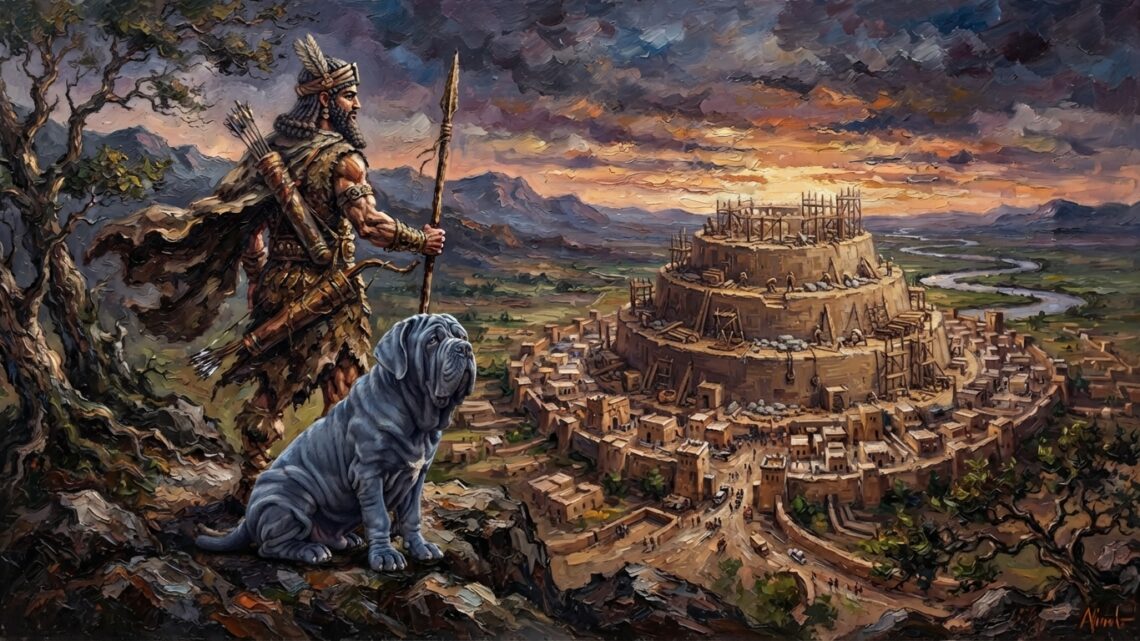
“Now Cush fathered Nimrod; he became a mighty one on the earth. He was a mighty hunter before the Lord; therefore, it is said, ‘Like Nimrod a mighty hunter before the Lord.’” Confronted with this break in the pattern, we ask our crucial questions: “Why does the author tell us so much about Nimrod, when he tells us so little about the others,” and “Why does he tell us now, in the middle of a genealogy?”
Without more information, we cannot answer either question, so we must read on. Next the author returns to this genealogy’s pattern and describes Nimrod’s territory: “And the beginning of his kingdom was Babel, Erech, Accad, and Calneh, in the land of Shinar.”
Note Nimrod’s first named city: Babel. This genealogy records the filling of the earth with people. It tells what they did, but not why.
Cain had escaped death, but still received a sentence to be ‘a restless wanderer on the earth.’ Ever rebellious, he founded a city instead. Chapter 11 tells us Nimrod did the same thing. Commissioned with filling the earth twice, once at creation, and once again at re-creation, rebellious humanity seeks to defy part of that commission. Instead of dispersing to fill the earth, they cluster together.
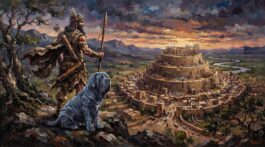
Lest we doubt their intentions, they state them explicitly: ”Come, let’s build ourselves a city, and a tower whose top will reach into heaven, and let’s make a name for ourselves; otherwise we will be scattered abroad over the face of all the earth.” They build a city to avoid being scattered. Remembering the Flood, they set about to not only defy His commission, but to eliminate his ability to punish them for that defiance.
They will “a tower whose top will reach into heaven.” That way, they can survive a flood of water that covers the earth.
And they “will make a name for themselves.” In the Old Testament, name is character. Jacob the supplanter becomes Israel, the one who wrestles with God. After the birth of Ishmael, Abram becomes Abraham, the father of many nations when God foretells him of Isaac as the son of the promise. The inhabitants of Babel will make their own character, thank you.
This demonstrates they still believe the Serpent’s lie: they think they can become as God, resisting his power and pursuing their own desires.
But God will not be mocked. They have chosen the path of the Serpent, the path of chaos and disorder, so God gives them what they have chosen: confusion of languages. Pentecost will later reverse this for at least one day, where communication bridges different languages. But at Babel, confusion reigns and renders their efforts futile.
All this leaves the reader with a significant question. God used a flood of water to cleanse the planet from a culture of violence, but the central problem of sin remained. God had delivered humankind through Noah, but neither he nor his descendants can overcome the problem of sin that infects all humankind.
The renewed Fall, the renewed defiance of humanity’s true calling, the tower of Babel made that clear. So the reader wants to know, “How will God act to deliver humanity from sin itself?” And the answer to that begins with yet another genealogy.