














Sabbath School Lesson for August 16-22, 2025
Introduction of Lesson 8, Covenant at Sinai
Memory Text: ” ‘ “You have seen what I did to the Egyptians, and how I bore you on eagles’ wings and brought you to Myself. Now therefore, if you will indeed obey My voice and keep my covenant, then you shall be a special treasure to Me above all people; for all the earth is Mine. And you shall be to Me a kingdom of priests and a holy nation…” ‘ ” Exodus 19:4-6 NKJV
Being caught up on eagles’ wings is vivid imagery of God allowing us to rise above all our hardships. The Hebrews’ deliverance from slavery must have felt like they were rising up on the safe wings of an eagle.
Notice where God first took them on eagles’ wings though. The verse reads: “and brought you to Myself”. First, they must come to Him. It is only when we are traveling in companionship with God that we can reach our destination of a Promised Land like Canaan.
God always takes the initiative in our relationship. Even in the Garden of Eden, it was God who went searching for the guilty pair. He longs to take each of us with our imperfections and make us a special, valued treasure. We can only do this by coming to Him for rest (Matthew 11:28-29). His yoke is easy, and the children of Israel were soon to find out what that “yoke” was and what their obedience to it could do for them.
- Sunday: At Mount Sinai
- Monday: Preparing for the Gift
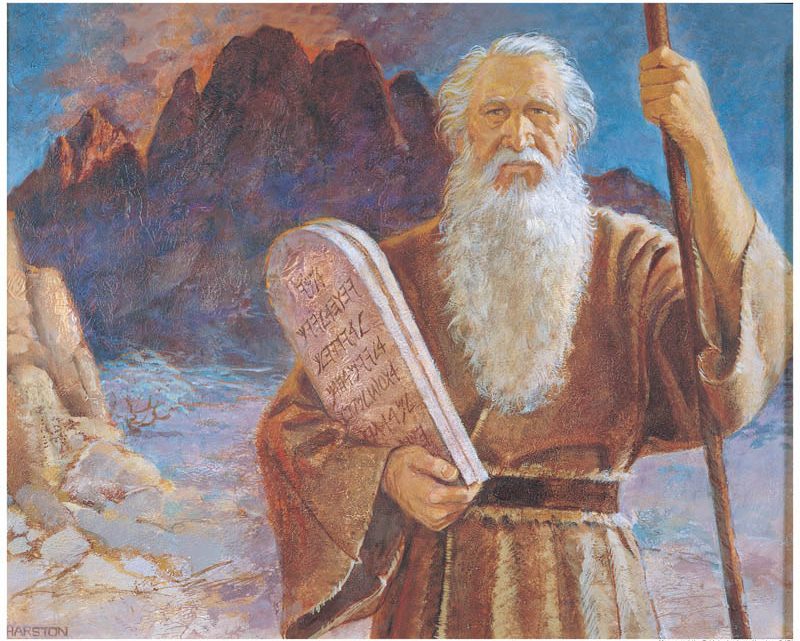
- Tuesday: The Gift of the Decalogue
- Wednesday: Different Functions of God’s Law
- Thursday: The Law as God’s Promise for Us
Sunday: At Mount Sinai
After about two months of travel (Exodus 19:1), they were near Mount Sinai, also called Mount Horeb (Exodus 3:1), which was the site of Moses’ meeting God at the burning bush and receiving his call to shepherd God’s people out of Egypt. With an elevation of 7,497 feet or 2,285 meters, the mountain, Jebel Musa, was also the place where Elijah met God as he was fleeing from Jezebel (1 Kings 19:8).
It’s understandable that Jethro would visit Moses when the Israelites were camped at the southern part of the Sinai peninsula, as we learned in chapter 18 of Exodus. It was the area where Moses had been shepherding with Jethro’s family.
Meeting God at Mt. Sinai again was important to Moses. God had declared that meeting with Him and the liberated Hebrews would be a sign that it was God who was leading them (Exodus 3:12). So, Moses was looking forward to seeing their Benefactor again on what came to be known as the mountain of God.
They remained encamped there for one year (Numbers 10:11-12), learning all they could about dedicating themselves to God, so they could become a holy nation, a kingdom of priests. They would need to learn all they could about God in order to reflect His character to the heathen tribes they would later meet in and near Canaan.
Verses and questions:
Exodus 19:1-8
- What did God promise them at the base of Mt. Sinai?
- What would it mean to be God’s “special treasure”?
- What responsibilities and privileges would be involved in becoming a holy nation?
Monday: Preparing for the Gift
Before God would declare the terms of their covenant/contract, writing them on two tablets of stone, He instructed the people to consecrate, or dedicate, themselves for this sacred calling. They were told to wash their clothes, which symbolically showed their willingness to purify their lives before God (Exodus 19:10).
The gift of the Ten Commandments (or Decalogue) was a complete revelation of what God expects of His people. It included a standard of ethics that would benefit all humanity. Love certainly was the main characteristic of the Law and the best way to describe who God is. 1 John 4:16 verifies that “God is love”.
Exodus and Deuteronomy (the two places where God’s requirements are specifically listed) does not call them the Ten Commandments in the Hebrew language. Instead, they are referred as the “Ten Words”. The gospel of John declares that the Word was made flesh in the form of Jesus. So, God’s Son, the Word, was present at Creation (John 1:1-3), but also during the momentous giving of His Law/Word at Sinai. The Decalogue was God’s spoken gift of Himself to mankind.
Verses and questions:
Exodus 19:9-25
- What kind of preparation was needed for Israel to receive the Ten Commandments?
- How can we prepare ourselves to receive God’s Word?
Romans 13:8-10 and 1 John 4:16
- If love is all we need, then why does God need to define it so elaborately in the Ten Commandments?
Tuesday: The Gift of the Decalogue
Before giving commands, God reminded the people of His loving actions in securing their release from bondage in Egypt (Exodus 20:2). They had seen the lengths God would go to show His mercy and love for them. Now it was time for them to learn how to love Him in return.
The first tablet contained four ways they could show reverence to God. He would be honored if they made Him first, stopped bowing down to other gods, used His name responsibly, and kept holy the day He gave them to celebrate His creation.
Although they would often forget these commands (He even specified that they remember the fourth one), keeping the last six commands on the second tablet would prove just as difficult, if not more so. These commandments deal with our love for others. Treating our neighbors with love and respect is an important part of loving God.
We constantly need to respect our parents, life, marriage, other’s property, the reputation of others, and ourself by not holding onto selfish desires that weaken our spiritual connection to God.
Verses and questions:
Exodus 20:1-17 and Matthew 5:3-11
- How can we express these commandments in a more positive way, perhaps beginning with the words “Blessed be…”?
John 14:15, 1 John 4:20-21, and Matthew 25:40
- Whose commandments should we keep?
- What part does love have in keeping them?
- Why does loving our brother matter to God?
Wednesday: Different Functions of God’s Law
Their deliverance had shown the Israelites that God was holy, righteous, and good. And this is how God’s law is described in both the Old and New Testaments. It was also holy, righteous, and good (Romans 7:12 and Psalm 19:7-8).
The people would benefit greatly from knowing God’s character as it was described in the Decalogue and given to them at Sinai. Here are some of its functions:
- It would be like a fence, keeping them from the harmful things in the world.
- It would be like a mirror, showing them their imperfections.
- It would be like a sign to show them the way to Jesus, the Lawgiver.
Moses was diligent in showing them why they should keep the Law. Their obedience would make them a wise and understanding people, and most importantly, it would give them life, both now and for eternity. See Deuteronomy 4:1-6 and Proverbs 2 and 3.
Verses and questions:
James 1:23-25 and Romans 7:7
- What can the Law do and what can it not do for us?
Thursday: The Law as God’s Promise for Us
The Israelites thought their final destination was going to be Canaan, the Promised Land full of milk and honey. Romans 10:4, however, says that Christ was “the end of the law for righteousness to everyone who believes”. The place God desired for them was not just a physical place, but a Person.
The Ten Commandments, or Ten Words, are actually promises that would draw us closer to Himself. The Hebrew word “dabarim” (Words), used to describe the Decalogue, can also have the meaning of “promises”.
How comforting to know this added function of the Law being a Promise. And this is why Paul was careful to point out that we aren’t saved by the Law. We need God’s grace and Christ’s righteousness to be saved (Romans 3:20-24). He was the promised Messiah. It is faith, not works, that get us to our promised destination with Him (Ephesians 2:8-9).
Verses and questions:
Romans 3:20-24
- How should the Commandments function in our lives?
- What is their purpose? How can they be seen as promises?
Romans 10:4
- What does it mean by saying that Christ is the “end of the law”?
Friday: Final Thoughts
In conclusion, we must not think of the Ten Commandments as a one-sided set of rules we must keep in order for God to love us. He loves us whether we keep His rules or not. They merely provide a framework of ways we can express our love for God, in return for how much He already loves us–enough to die for us (Romans 5:8). Jesus said it plainly: “If you love Me, keep My commandments” (John 14:15). Loving Him must come first!
After realizing how much God loves us and how dependent we are upon His mercies, our hearts are filled with thankfulness and reverence for His mighty works in the universe. The more we see of His holy greatness, the greater our imperfections will appear and the more we will want to please Him by obeying His commands.
This is when we realize that His commands are not difficult at all (1 John 5:3). Love makes all the difference. As Ellen White tells us: “All His biddings are enablings” (Christ’s Object Lessons, p. 333).
Read more about God’s law in these two short articles:
https://www.outlookmag.org/the-ten-blessings-of-god/
and https://www.outlookmag.org/how-to-keep-the-ten-commandments/

No Comment