














Sabbath School Lesson for August 2-8, 2025
Introduction of Lesson 6, Through the Red Sea
Memory Text: “And Moses said to the people, ‘Do not be afraid. Stand still, and see the salvation of the Lord, which He will accomplish for you today. For the Egyptians whom you see today, you shall see again no more forever. The Lord will fight for you, and you shall hold your peace.’ ” Exodus 14:13-14 NKJV
Geographically, the Hebrews were in a tight spot indeed. Following the cloud by day, God had led them to the shores of the Red Sea (literally “the sea of reeds”). There were mountains on both sides, with Pharaoh’s army pursuing them from behind.
The widest part of the Red Sea, which would have been about 190 miles, was probably not the setting for this event. It’s thought to have happened somewhere at the northern end of the Gulf of Suez, part of the Red Sea, where the width could have been only six miles, or ten kilometers. This still would have required a miraculous event. And they were not disappointed in how the Lord saved them from the angry army of charioteers Pharaoh had recruited.
This divine act of God is a reminder for us of the hopeless state of sin we are in and the deliverance that has been ordained to save us. Things looked grim and hopeless for the followers of Jesus, too, as He was marched off to His execution. There were enemies on all sides. But a miraculous resurrection was soon to restore their faith and give all of mankind freedom from their cruel bondage of sin. The Exodus, thus, was a foreshadowing of what Christ did for us on the cross.
- Sunday: Go, and Worship the Lord
- Monday: Consecration of the Firstborn
- Tuesday: Crossing the Red Sea
- Wednesday: Marching Forward by Faith
- Thursday: The Song of Moses and Miriam
Sunday: Go, and Worship the Lord
Finally, Pharaoh relented and allowed the Hebrews to go worship God, as he had originally been commanded to do. The horrific punishment of the tenth plague that fell on his nation, including his own household, really gave the proud ruler no choice but to finally comply with the demands of God.
Losing their valuable firstborn sons had led the king to even request a blessing for himself from the powerful God who had allowed this terrible judgment (Exodus 12:32). As the rest of the story shows us, the king’s request did not appear to come from any true submission to the God of Moses. It appeared to be his only recourse to stop the destruction of his land and people.
Even the Egyptians were anxious for the Hebrews to leave Goshen, before more painful consequences came upon them (Exodus 12:33). They gladly parted with articles of gold, silver, and clothing, too, in order to hasten their departure. God had instructed the Israelites to ask for such items, as they were actually part of the wages owed them for their long years of servitude. This amazing deliverance was clearly not just an act of judgment, but evidence of God’s justice and mercy for all who are oppressed.
Verses and questions:
Exodus 12:31-36
- What were probably the reasons why Pharaoh agreed to the demands of Moses at this time, and why would he ask for a blessing upon himself?
- Why did God encourage the plundering of the Egyptians as the Hebrews left Goshen?
Monday: Consecration of the Firstborn
Firstborn children understandably hold a special place in the hearts of parents and grandparents. They represent the first fruits of God’s blessings, making us realize in a tangible way what a wonderful Creator God we serve.
Therefore, the firstborn sons of the Israelites were consecrated in a special way to God. They had been spared from death in the final plague in Egypt, when their families put the blood of a sacrificed lamb on their doorposts and lintel. The firstborn of their animals were sacrificed to God, but the firstborn sons were consecrated to God with the celebration of the Passover. This commemorative event was to be kept always before their eyes and on their hands (Exodus 13:16), representing both their thoughts and actions.
The entire Passover celebration pointed forward to the future Messiah, “the firstborn of all creation” (Colossians 1:15). The shed blood of the Lamb of God (John 1:29) must be on the doorposts of our hearts today and always. Our Deliverer knocks on the door of everyone, waiting for us to invite Him in (Revelation 3:20).
Verses and questions:
Exodus 13:1-15, Colossians 1:14-15, and John 1:29
- How did the Passover service point forward to Christ?
Exodus 13:16 and James 2:20
- Why is it important to have faith (in our minds), but also to have works (what we do with our hands)?
Tuesday: Crossing the Red Sea
The military training Moses received in pharaoh’s palace as a youth was evident in the orderly way the Israelites left Goshen. It was “according to armies” in Exodus 12:51, which some have translated as “according to their divisions”. Instead of military units or battalions, we find that they were divided according to their families, or tribal units. We are told there were about six hundred thousand men, so we can assume it was a massive group of people, probably close to two million counting women and children (Exodus 12:37). Organization would have been vital for their safety and comfort.
Moses was also impressed by God to take the bones of Joseph with them (Exodus 13:19). Even though Joseph lived in the splendor of Egypt, he never lost his love for the promised land of Canaan, and requested his bones be buried there–which they were (Joshua 24:32).
Despite Pharaoh’s willingness to let the coveted slave population leave the country, he very soon had second thoughts and gathered an army of skilled charioteers to go with him after the escaping Hebrews. When God’s children realized they were being pursued and that the cloud and pillar had led them to a very dangerous spot, they, too, had second thoughts about their decision to follow the instructions of God through Moses. See Exodus 14:11.
Verses and questions:
Exodus 13:17-14:12
- How did God guide the Israelites and what challenge was there when they got to the waters of the Red Sea?
- Why do people, even today, question and complain about the way God leads them? What might be a better response when we face trials?
Wednesday: Marching Forward by Faith
The miraculous escape of the Israelites when the waters of the Red Sea parted was possible only when they listened to God, through Moses, and did the following (Exodus 14:13-14):
- lost their fear and remembered that God was with them
- stood still (or stopped murmuring) and waited for God to act
- opened their eyes to see how God would save them
- knew in their hearts that God would fight for them
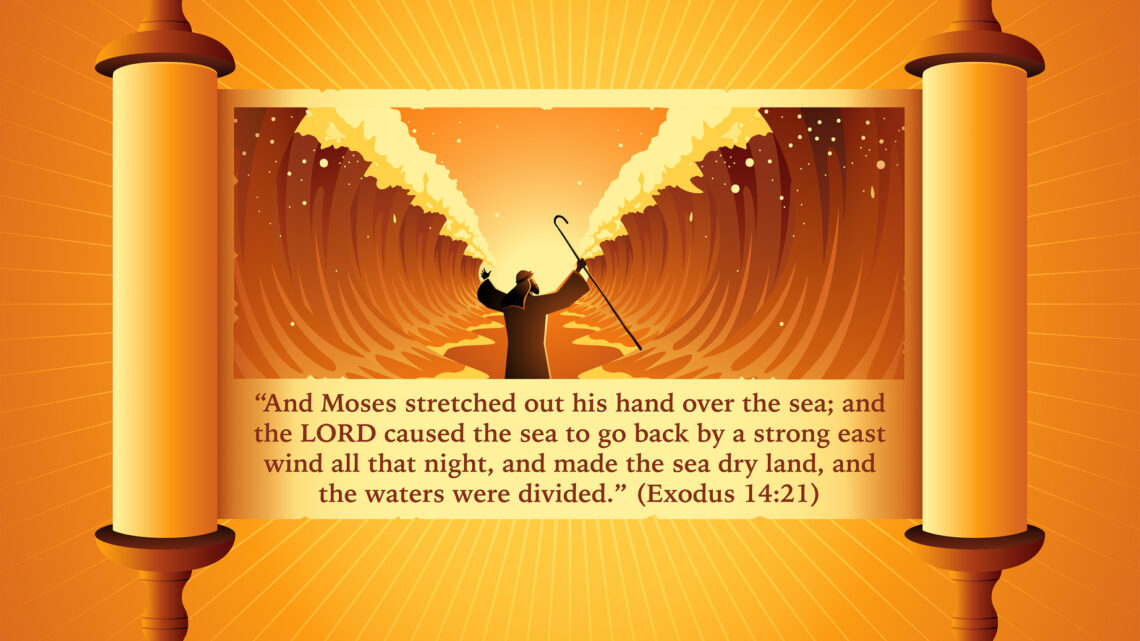
After Moses lifted his rod above the waters as God had instructed, the waters of the sea parted, leaving dry land that they could walk on to escape the Egyptians. But the Egyptians also began to cross through the divided waters with their swift chariots.
God’s presence in the cloud suddenly moved from the head of the Israelites and appeared behind them. This caused immediate confusion and trouble for Pharaoh’s army, making it difficult to see their path ahead. Their chariot wheels began falling off, causing many of them to turn back from the pursuit. And after the Hebrews had safely crossed, Moses once again raised his rod and the waters came crashing down on the charioteers, drowning them all, including their surprised leader.
Verses and questions:
Exodus 14:13-31
- What kind of miracles have you experienced that helped you move forward in your Christian walk?
Isaiah 41:10, 13
- Why is it easy to have fear, and what is the best way to conquer it?
Thursday: The Song of Moses and Miriam
After seeing dead Egyptians on the seashore, the Israelites broke into a song of thanks for God’s protection and deliverance. Moses, their choir director, accompanied by his sister Miriam and the women with timbrels and dancing, lifted up their voices together in joyful praise and love for their mighty God.
The words of Moses’ song captured the emotions felt in their hearts, and it must have touched God as well. We are told in Revelation that this same song, accompanied this time with harps, will be repeated when His people someday stand on the sea of glass on the shores of their heavenly home. The song they sing then is called the Song of Moses and the Lamb and rightly represents the love of God and our heartfelt thanks for being delivered from our sin-laden planet.
Exalting and praising God through song has always been a way to revitalize our Christian experience. Singing about our worthy God will be an activity we’ll happily enjoy throughout eternity.
Verses and questions:
Exodus 15:1-21
- What were some of the things they praised God for and why did they do it?
Revelation 15:2-4
- Compare this event to the one in Exodus. How are they similar, and how are they different?
- Why do you think it’s called a sea of glass? What might that symbolize?
Friday: Final Thoughts
For many people, calling out to God is most likely to happen when we are faced with some oppressing difficulty. But, even then, we often reach out with a complaining, murmuring spirit, instead of a heart of faith in God’s ability to save.
The Song of Moses in Exodus 15 is a longstanding reminder that God is a worker of miracles. He is our strength and salvation, two things alone that qualify Him to save us from our circumstances, no matter how pressing and impossible it may seem at the time.
It certainly helps to remember the powerful God we serve, when we remember to praise Him during the good times of our life. He is with us always, no matter what we’re going through, good and bad. So, let’s remember even more to recognize that and praise Him always.
Next Week: The Bread and Water of Life
To read the Sabbath School Lesson Quarterly and see more resources for its study, go to

No Comment