















Sabbath School Lesson for July 19-25, 2025
Introduction of Lesson 4, The Plagues
Memory Text: “So the heart of Pharaoh was hard; neither would he let the children of Israel go, as the Lord had spoken by Moses.” Exodus 9:35 NKJV
The Egyptians may have felt that the Israelites were a military threat at the beginning of their enslavement, as Exodus 1:10 seems to suggest. But as time passed, their greedy desire for free labor surely kept the Hebrews in such a pitiful condition of bondage for many years. It would require miracles of some kind to get the attention of their king and taskmasters. And God had plenty of signs and wonders in store for them.
The words, “Let my people go”, were not spoken by Moses in the Bible as a request to Pharaoh. It was a divine command. It was something the hard-hearted king had no choice but to do, even if he stubbornly did not see it that way. God’s promise to bless His people would be kept, one way or another.
Mercifully, God sent Pharaoh and the Egyptians ample evidence of the Creator’s authority to make such an outspoken demand. Plagues ripped through their land just as Moses predicted, stripping away any supposed divinity their worthless creature gods claimed to possess.
- Sunday: God vs. gods
- Monday: Who Hardened Pharaoh’s Heart?
- Tuesday: The First Three Plagues
- Wednesday: Flies, Livestock, and Boils
- Thursday: Hail, Locusts, and Darkness
Sunday: God vs. gods
No one could accuse the Egyptians of not being a religious nation. They worshipped over 1,500 deities. And pharaohs were thought, of course, to be the embodiment of one or more of them as well. The Creator God of Moses, however, would ultimately prove Himself stronger than any of their “creature gods”.
We must keep in mind that God was not fighting against the Egyptian people, although they suffered many things. He was actually at war with the many gods they venerated (Numbers 33:4). The idolatrous practices of the Egyptians had turned them into cruel taskmasters. God wanted nothing more than to save them, just as He was about to save the Hebrews from slavery. It was a choice they all had to make. Would they worship the true God or their own gods?
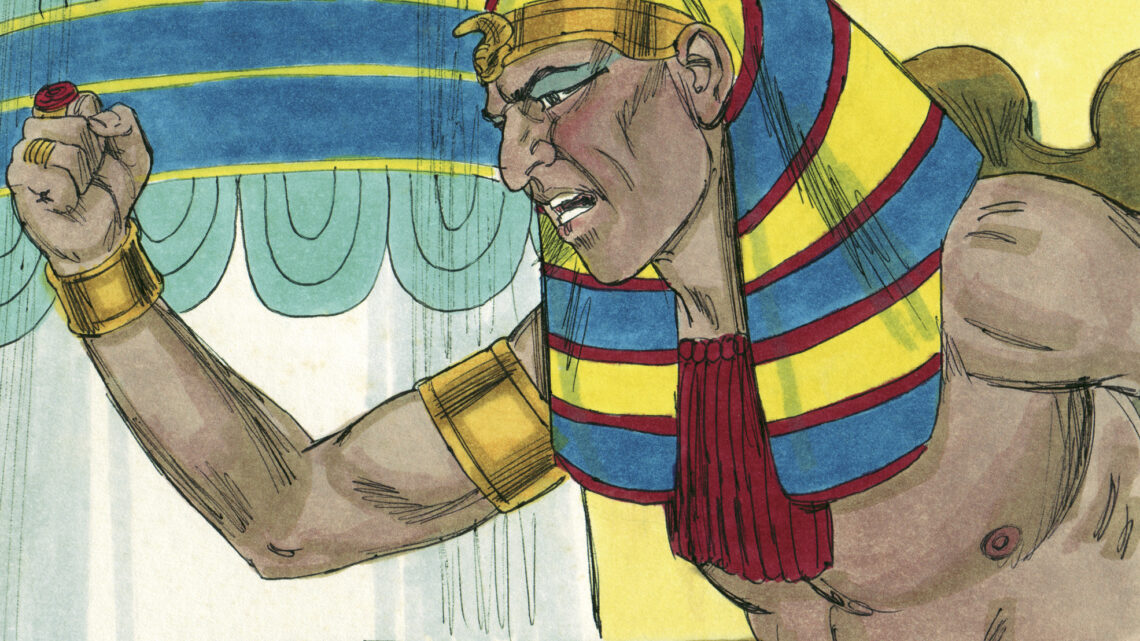
The first sign Moses used to persuade them of God’s power was when his rod turned into a snake that devoured seven of the magicians’ snakes. The Uraeus goddess Wadjet was seen as a cobra and was all-powerful in lower Egypt. There was even a symbol of a cobra on Pharaoh’s crown. They thought this serpent would spit poisonous venom at pharaoh’s enemies and would guide him to his afterlife.
Interestingly, there was an ancient Egyptian myth before Moses’ time about a serpent god whose name was Nehebkau, which meant “he who harnesses the spirits”. According to the myth, this serpent god swallowed seven cobras. That first miracle of God was certainly designed to give them a convincing, lasting impression of God’s superior power and authority.
Verses and questions:
Exodus 7:8-15 and John 10:11
- Why was God using the rod of Moses to perform His miracles?
- Compare the ruler’s scepter with a shepherd’s rod. How might Jesus have been included in the symbolism of the rod, making it a useful tool for Moses and Aaron to impress the Egyptians of God’s power?
Monday: Who Hardened Pharaoh’s Heart?
We can see how God worked diligently for Pharaoh to obey the command to let God’s people go. The hardening of his heart that made it difficult though was a process that began with pharaoh’s own choices to disregard the God of Moses.
The verses related to his choice seem to go back and forth in who was responsible for the weighty decisions he made. Did God harden his heart, or was it solely the choice of Pharaoh? There does seem to be some verses that indicate God’s strengthening or deepening that choice later in the story.
According to Deuteronomy 30:19 and many other verses, we all have a choice to make between life or death, blessing or cursing. There is no reason why Pharaoh would be any different. We also know from other examples in the Bible that there comes a time when God’s voice may stop speaking to us and God allows the consequences of our mistakes to be felt. But thankfully, even then God can use the experience to enlighten others and prevent them from going down the same wrong path.
Verses and questions:
Exodus 7:3, 22, Romans 1:22-24, and Matthew 12:31-32
- How might the unpardonable sin of blaspheming the Holy Spirit be useful in understanding the process of pharaoh’s heart becoming hard?
- How and when were both Pharaoh and God involved in the king’s heart being so hard?
- In what ways do we allow our own hearts to become hardened?
Tuesday: The First Three Plagues
God strategically decided that the first plagues would involve water. Hapi was considered the god of the Nile. It is believed by some that Moses’ full Egyptian name may have been Hapimose, based on the story of his rescue from the Nile as an infant.
Using his rod of authority again, Moses stretched it out over the Nile River, causing the water to turn into blood and killing all its fish and aquatic life. The people, too, suffered from lack of water to drink. Instead of providing life, the river they revered was a source of death.
Since this didn’t prove enough to soften Pharaoh’s heart, Moses waved his rod over the waters again and caused frogs to rise up out of the river and cover the land, making life miserable for all of Egypt’s inhabitants. Their frog god, Heqet, was thus turned into something the people detested and wanted to go away. This time Moses predicted exactly when the frogs would disappear from their homes, courtyards, and fields–another indication that Moses’ God was more powerful than the gods of the Egyptians.
The third plague occurred when Moses struck the dust of the earth with his rod, turning the dust into lice. Their pagan god Geb, the god of the earth, was therefore attacked by God. We aren’t told as much about this plague, and the Hebrew word for lice is unclear about which insect it may have been. But whether it was lice, ticks, gnats, or mosquitoes, it made the lives of man and beast very unpleasant.
This time the magicians’ enchantments failed to produce lice, convincing them of the superiority of the God of Moses. They even pointed this out to the king, but he refused to listen to the mounting evidence.
Verses and questions:
Exodus 7:14-8:19
- Who benefited from seeing these manifestations of God’s power, besides Pharaoh?
Wednesday: Flies, Livestock, and Boils
With the lice plague still fresh in their minds, Moses warned them of another insect plague God would send to get their attention: swarms of flies. As we might expect, there was an Egyptian god for flies as well. This time, however, the plague would only affect the houses of the Egyptians. God’s people in Goshen would miraculously be spared, further evidence of the Creator’s superiority over the Egyptian deities. It happened on the following day, just as Moses predicted, and this time Moses didn’t need his rod. God just made it happen.
Pharaoh appeared to relent some at this point. He offered to let the Hebrews offer sacrifices, but they must do it in Egypt. Moses would not accept this concession, however. He knew how much hatred and violence it would create, since the animals they would sacrifice would be those still considered sacred by many of their taskmasters.
After Moses interceded and God removed the flies from their land, he announced the fifth plague. This one would also defeat several Egyptian gods. It would be a pestilence upon their livestock. Again, animals in Goshen would be free of the deadly disease. All the Egyptian animals would languish and die.
Since this plague failed to soften Pharaoh’s heart, the sixth one caused ugly, painful boils to appear on both man and beast in the land of Egypt. The sores were so bad that the magicians could not even appear before Pharaoh. But still, he refused to let God’s people go.
Verses and questions:
Exodus 8:30-9:12 and Proverbs 4:23
- With all the rational evidence before Pharaoh, why did he still refuse to obey God’s command?
- What does this situation tell us about the need for us to guard our hearts?
Thursday: Hail, Locusts, and Darkness
So far God had shown Egypt plagues associated with water, then with the earth, and now the seventh, eighth, and ninth plagues involved the heavens. This would be expected of our God, who created the heavens, the earth, and the sea (Exodus 20:11 and Revelation 14:7).
The seventh plague, hail falling from the sky, is associated with judgment (Isaiah 28:2, 17 and Revelation 16:21). This time, however, the Egyptians could save themselves and their flocks by seeking shelter before the storm began. Many of them complied, having been convinced of God’s superiority, and wanting to be free from their worthless deities, which had kept them in bondage for so many generations.
Then, a mighty wind blew from the heavens, and a plague of locusts descended upon the land of Egypt, devouring everything that had not been damaged from the hail. After this plague was over, Pharaoh offered to let the men alone go out of Goshen to worship God, but Moses said that they would not go without their families. Women and children were important members of their faith community and needed to be included.
The ninth plague again involved heaven. Moses stretched out his hand toward heaven, as he had done with the previous two plagues, and caused darkness to fall upon all the Egyptians–but not on the Israelites in Goshen. For three days, the Egyptians stumbled around in complete darkness. Pharaoh appeared to soften halfheartedly again, this time by saying they could all go out of Goshen, but not with their flocks and herds, which they needed to make their sacrifices.
Of course, God can only accept our complete surrender, so Moses turned down his offer again, forewarning Pharaoh that the next, final plague would be the worst of all.
Verses and questions:
Exodus 9:13-10:29
- Why did God keep turning down Pharaoh’s offers to let the people go?
- Thinking back to the order of creation week in Genesis 1 (first the light and firmament, then the dry land and plant life, and finally the waters and sea creatures), what might be the significance of the order of the plagues that fell in Egypt, happening in the opposite order?
Friday: Final Thoughts
We learn so much about God and the great controversy between Satan and Christ through the events in Exodus. God wanted to free His people from their cruel enslavement and keep the promises He had made with Abraham, but He would use the situation to save many others in Egypt who had become slaves of idolatry. He would accomplish this by defeating their creature gods one by one during the plagues that came upon the land.
The loving mercy of God was evident in the ninth plague of darkness, because it encouraged a time of quiet reflection for those Egyptians who were still clinging to their deities. Many times it is in our darkest hours that God’s light shines brightest.
“He would give the people time for reflection and repentance before bringing upon them the last and most terrible of the plagues.” Patriarchs and Prophets”, p. 272. What a patient, heavenly Father we have.
Next Week: Passover
To read the Sabbath School Lesson Quarterly and see more resources for its study, go to

No Comment